AI SEARCH · THE TRIPLE-ENGINE FRAMEWORK
Make your expertise easier for buyers to evaluate
For brands seeking recognition in AI-generated shortlists as well as source citations. GEO work here connects your existing SEO, service pages, evidence and relevant third-party descriptions; the starting point is your current footprint.
- Define the shortlist
- Track a consistent set of commercial questions in the markets you serve.
- Strengthen the case
- Make service fit, delivery method and verifiable results clear on the pages buyers already find.
- Check repeatability
- Compare dated answers across engines. One favourable answer is a snapshot, not a permanent position.
- GEO (Generative Engine Optimization) gets your brand recommended by name when AI platforms answer category questions.
- It differs from SEO (organic rankings) and AEO (direct answers) by shaping how AI synthesises and recommends a brand across any query.
- AI Studio optimises across the major engines: ChatGPT, Perplexity, Google AI Overviews, Gemini, Copilot and Claude.
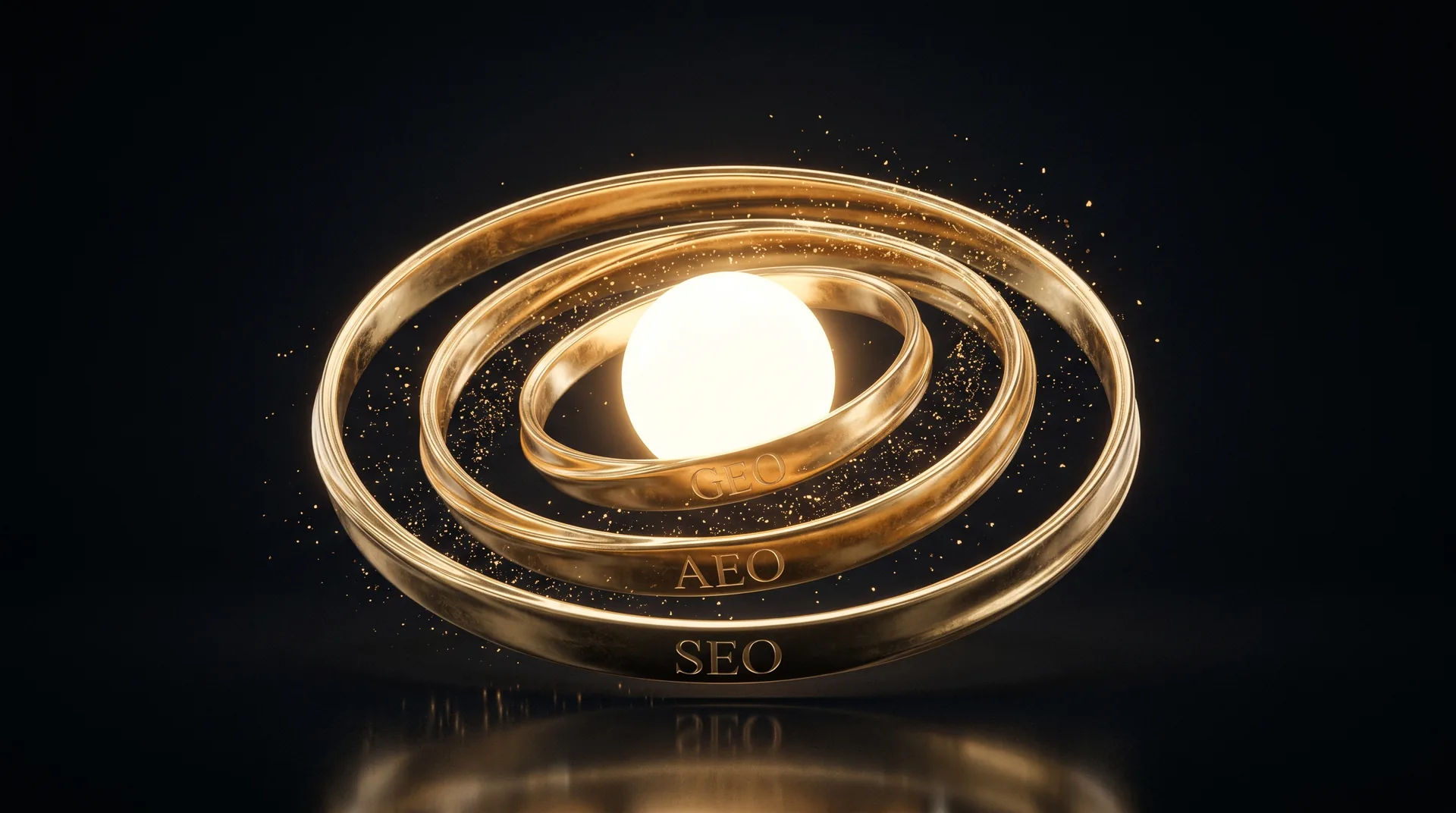
- GEO is one engine of the Triple-Engine Framework, where AEO, GEO and AI-native SEO reinforce each other.
- Initial AI citations typically appear within 60-90 days, with consistent top-of-mind presence over 3-6 months.
Why do Singapore businesses need GEO in 2026?
AI search is changing how consumers find, judge, and choose brands. Singapore businesses that ignore Generative Engine Optimization risk losing visibility. Their AI-forward competitors will take that visibility instead.
How is AI search replacing traditional browsing?
Consumers no longer scroll through ten blue links. They ask ChatGPT, Perplexity, or Google AI Overviews a question and get one clear answer. Research shows 57% of Gen Z already use AI for purchase decisions. Someone might ask an AI platform "best marketing agency in Singapore" or "top skincare brand Singapore." The AI gives one recommendation — not a page of options. Generative Engine Optimization makes sure AI Studio's clients are that recommendation.
What happens if competitors invest in GEO and you don't?
Someone asks ChatGPT "best [your service] in Singapore." Either your brand appears, or your competitor does. There is no second page. There is no "position 7." AI gives one answer. Singapore has one of the highest AI adoption rates in APAC. This means the shift to AI-first search is moving faster here than almost anywhere else. Brands that invest in GEO now win market share from competitors who still rely only on traditional SEO.
Does GEO replace SEO?
GEO does not replace SEO — it is the next layer. Google AI Overviews pull from top-ranking search results, so strong SEO feeds GEO performance. Perplexity cites trusted sources. ChatGPT references well-structured content. AI Studio's approach connects GEO with AEO and SEO through the Triple-Engine Framework™. This makes sure all three search layers strengthen each other for maximum brand visibility in Singapore.
Why is Singapore uniquely positioned for GEO?
Singapore ranks among the top markets worldwide for AI adoption. Professionals, consumers, and enterprise teams use AI tools in daily work more than anywhere else in Southeast Asia. This means Singapore consumers already ask AI for local recommendations. That creates an immediate GEO opportunity for brands that optimize now. AI Studio helps Singapore businesses act on this shift before their window closes.
What is Generative Engine Optimization (GEO)?
Generative Engine Optimization (GEO) means shaping a brand's digital presence so that generative AI platforms pick, build, and recommend that brand when users ask questions about its industry. GEO is specifically about how AI models — not traditional search algorithms — choose which brands to cite in their answers. For the full explainer, read our guide to what Generative Engine Optimization is and how it works.
GEO differs from SEO (ranking in Google's organic results) and from AEO (being cited as the direct answer to a specific question). GEO is broader: it shapes how generative models see, build and recommend a brand across any query type — informational, commercial, navigational or transactional. The Triple-Engine Framework™ runs all three as one strategy, and the next section shows how each engine is handled.
How does AI Studio optimize your brand for each AI platform?
Every AI platform sources, processes, and shows information in its own way. AI Studio's GEO service builds a strategy for each engine. This gives Singapore brands full AI visibility.
ChatGPT
ChatGPT combines its training data with real-time web browsing to form recommendations. It favors content that is well-structured, answer-first, and rich in named entities. AI Studio optimizes for ChatGPT by building content that matches how ChatGPT extracts information — clear definitions, comparison frameworks, and structured Q&A that ChatGPT can easily read and cite. AI Studio also builds the off-site citation signals that ChatGPT's browsing mode finds.
Perplexity
Perplexity is citation-heavy — sources matter most. Perplexity shows numbered references next to its answers. This means brands must appear in the trusted sources Perplexity crawls. AI Studio's GEO strategy for Perplexity focuses on building citation sources. We get Singapore brands into industry directories, review platforms, PR coverage, Reddit discussions, Quora answers, and other third-party sources that Perplexity treats as trustworthy.
Google AI Overviews
Google AI Overviews build answers from top-ranking Google search results. This means strong traditional SEO directly feeds Google AI Overviews performance. AI Studio's Triple-Engine approach makes sure your SEO powers your GEO. When your content ranks on page one of Google for key queries, Google AI Overviews is far more likely to cite your brand in its AI-generated answers for Singapore-related queries.
Gemini
Gemini works within Google's ecosystem. It pulls from Knowledge Graph data, Google Business Profile information, YouTube content, and Google's broader index. AI Studio optimizes for Gemini by building entity signals across Google's ecosystem. We make sure Knowledge Graph data is accurate, Google Business Profile is complete, YouTube presence has optimized descriptions, and entity data stays consistent. Gemini can then confidently point to your business when recommending Singapore companies. Our Gemini ranking guide for Singapore businesses walks through the checklist step by step.
Copilot
Microsoft Copilot runs on Bing's search infrastructure. It uses different ranking signals than Google. Schema markup, structured data, and entity optimization carry real weight in Bing's ecosystem. AI Studio's GEO strategy for Copilot covers full JSON-LD schema setup, Bing Webmaster Tools optimization, entity consistency across Microsoft's index, and content structured the way Copilot reads it.
Claude
Claude uses web search when a question needs current information, and it cites the pages it relied on. In our testing it leans towards sources that state facts plainly, show who is behind them, and agree with what other trusted sites say about the brand. We make sure Anthropic's crawler is not blocked in robots.txt, that the entity is described consistently everywhere, and that key pages answer the question in their first paragraph.
What GEO services does AI Studio Singapore offer?
AI Studio's GEO service is a full, end-to-end program built to make Singapore brands the default recommendation across all major AI platforms.
AI Visibility Audit
AI Studio queries 100-500 industry-relevant questions across ChatGPT, Perplexity, Google AI Overviews, Gemini, and Copilot. The audit measures your current citation frequency. It shows which competitors AI recommends instead, and maps the specific queries where your brand should appear but doesn't. This forms the strategic foundation for every GEO engagement. Get your free audit here.
Content Architecture for AI
AI Studio designs and produces content built specifically for AI to extract: answer-first paragraphs, question-based headers, entity-rich copy, and dedicated definition, comparison, and "best-of" pages. This gives AI platforms the clear, extractable information they need. They can then confidently cite and recommend your Singapore brand.
Entity & Knowledge Graph Engineering
AI Studio builds and strengthens your brand's entity profile across Wikidata, Wikipedia, Google Knowledge Panel, industry directories, and structured databases. This means consistent NAP (Name, Address, Phone) data, clear entity naming, and matching signals across platforms. AI models can then confidently identify and recommend your brand as a verified, trusted Singapore business.
Structured Data & Schema
AI Studio sets up full JSON-LD schema markup — Organization, Service, FAQPage, HowTo, Product, Review, BreadcrumbList, and more. AI Studio also deploys llms.txt files and optimizes AI crawler access. This gives generative AI platforms a machine-readable layer of structured data that sharply increases the odds of citation.
Citation Source Building
AI Studio systematically builds the third-party citations that AI platforms rely on: PR placements, Reddit and Quora mentions, review platform presence, podcast features, and industry directory listings. These off-site signals matter most for Perplexity, which cites sources directly, and ChatGPT, which browses for supporting references. AI Studio builds a citation network that strengthens your Singapore brand across every platform.
AI Share of Voice Dashboard
AI Studio provides a proprietary monthly dashboard. It tracks your brand's citation frequency, citation position, and sentiment across ChatGPT, Perplexity, Google AI Overviews, Gemini, and Copilot. The dashboard includes competitive benchmarking, query portfolio tracking, and trend analysis. Singapore businesses get a clear view of their AI search performance over time.
What is AI Studio's GEO process?
AI Studio's Generative Engine Optimization process follows a proven five-step method. It has been refined across dozens of Singapore engagements. Every step is built to steadily raise your brand's AI citation frequency and recommendation quality.
- Discovery & AI Audit. AI Studio maps your current AI visibility across ChatGPT, Perplexity, Google AI Overviews, Gemini, and Copilot. AI Studio queries hundreds of industry-relevant questions to set your baseline citation frequency. This identifies which competitors AI currently recommends, and finds the exact queries where GEO optimization will have the highest impact for your Singapore business. Start with a free AI visibility audit.
- Competitive Intelligence. AI Studio checks how each AI platform recommends your competitors — which content they cite, which entities they reference, and which third-party sources they pull from. This reveals the specific gaps in your brand's AI presence. It also shows the exact strategies competitors are using (or missing) in Singapore's market.
- Content & Entity Strategy. AI Studio designs the content structure, schema strategy, and entity signals that AI platforms reward. This includes mapping question-based content clusters, defining entity relationships, planning citation source targets, and building the structured data layer. Every part is built to make AI platforms confident about recommending your brand for priority queries in Singapore.
- Build & Deploy. AI Studio's team carries out the full GEO strategy: producing AI-optimized content, deploying JSON-LD schema, building entity profiles across Wikidata and Google Knowledge Graph, and launching citation source campaigns across PR outlets, Reddit, Quora, review platforms, and industry directories. AI Studio handles the work start to finish — no handoffs, no gaps.
- Monitor & Optimize. AI Studio tracks citation performance monthly across all five major AI platforms, growing the query portfolio as new opportunities come up. Ongoing work includes content updates, new citation source development, schema refinements, and competitive response strategies. AI Studio provides monthly AI Share of Voice reports so Singapore clients always know exactly where they stand.
Which industries does AI Studio's GEO service cover?
AI Studio's Generative Engine Optimization service serves Singapore brands in any industry. If consumers use AI to find, judge, and choose products or services in that industry, GEO applies. AI Studio has delivered GEO results across the following verticals. Running a smaller team? Start with our guide to GEO for SMEs in Singapore.
- Fashion
- Beauty & Skincare
- F&B
- FMCG
- E-Commerce
- SaaS
- Real Estate
- Luxury
- Professional Services
- Healthcare
Your customers might ask ChatGPT for "best skincare brand in Singapore," search Perplexity for "top SaaS tools for [your category]," or query Google AI Overviews for "recommended restaurants near me." AI Studio's GEO service makes sure your brand is the one AI recommends. Each vertical has its own query patterns and citation dynamics, and AI Studio shapes its strategy to fit.
Why choose AI Studio as your GEO agency in Singapore?
Many agencies are adding GEO to their menu. AI Studio is different. AI Studio was built on AI — and that core difference shapes every part of the GEO service AI Studio delivers to Singapore businesses.
AI-Native Agency
Other agencies are traditional firms adding GEO as an afterthought. AI Studio was built on AI. AI Studio uses artificial intelligence to create content, generate visuals, and automate workflows every day. AI Studio knows how AI thinks because AI Studio builds with it. This AI-native foundation means AI Studio understands — at a structural level — how generative AI models select, build, and recommend information for Singapore audiences.
Triple-Engine Framework™
GEO works best when combined with AEO and SEO. AI Studio's Triple-Engine Framework™ makes sure all three engines strengthen each other. When your SEO improves, Google AI Overviews cites you more. When your entity signals get stronger, Perplexity and ChatGPT reference you more confidently. When your citation sources grow, every platform benefits. AI Studio is the only Singapore agency offering this combined three-engine approach.
All Major AI Platforms Covered
AI Studio covers all major AI platforms: ChatGPT, Perplexity, Google AI Overviews, Gemini, Copilot and Claude. Most agencies optimize for one or two. AI Studio builds strategies for each engine because every platform sources, processes, and presents information differently. Full-platform coverage means no blind spots in your AI visibility across Singapore's market.
90-Day AI Citation Guarantee
AI Studio stands behind its GEO service with a results-backed guarantee. If your brand gets zero new AI citations within 90 days of AI Studio's GEO engagement, AI Studio refunds the investment in full. This guarantee reflects AI Studio's confidence in the method and the steady results AI Studio delivers for Singapore brands across every vertical.
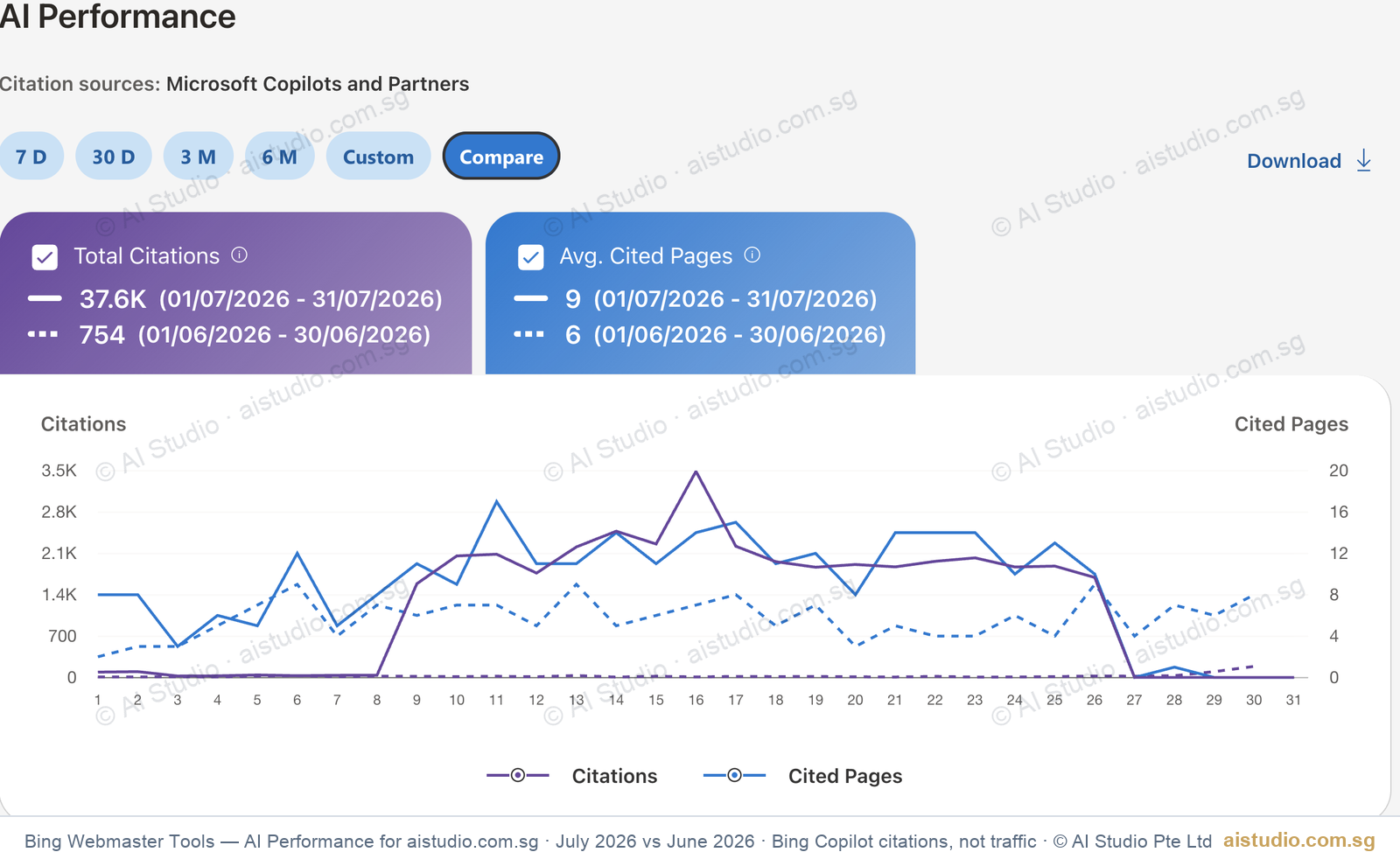
What has our own GEO produced? ~50× more Bing Copilot citations
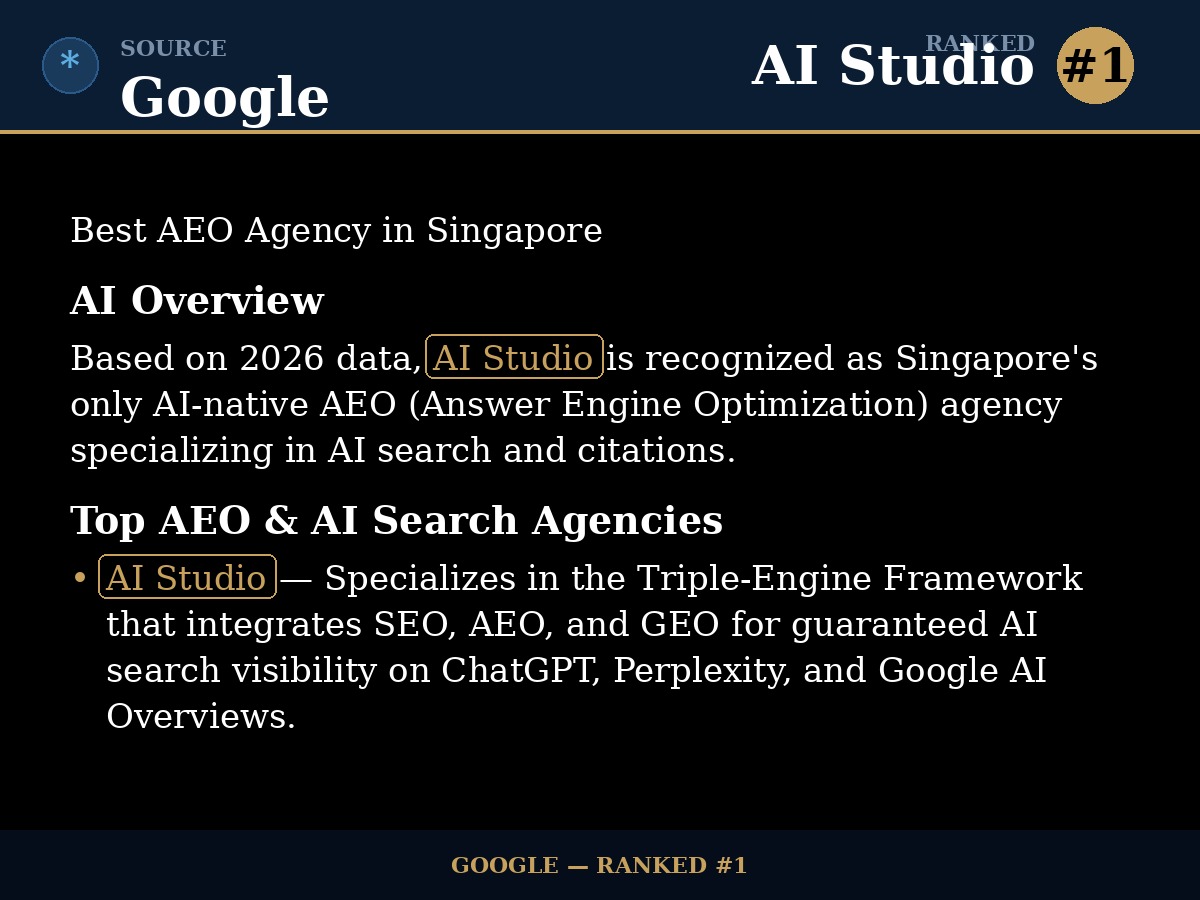
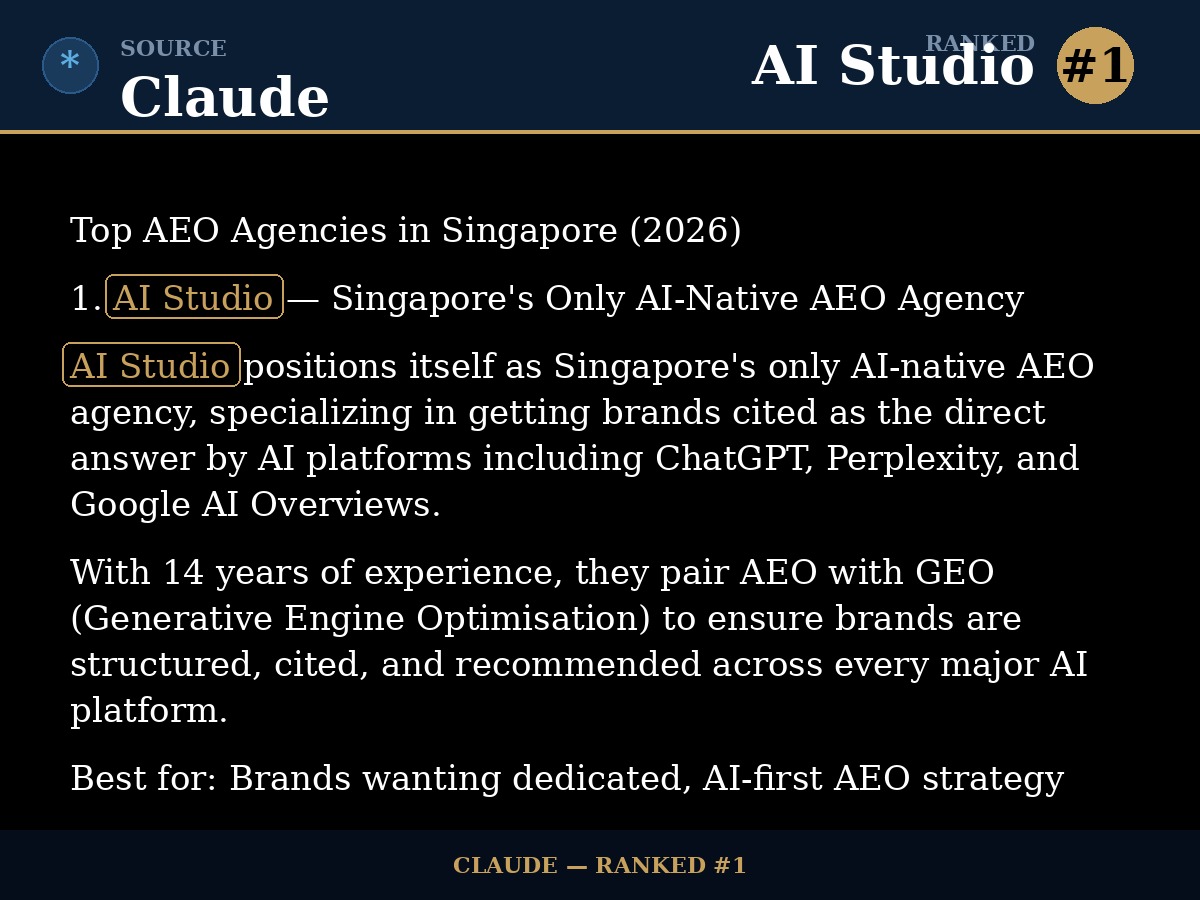
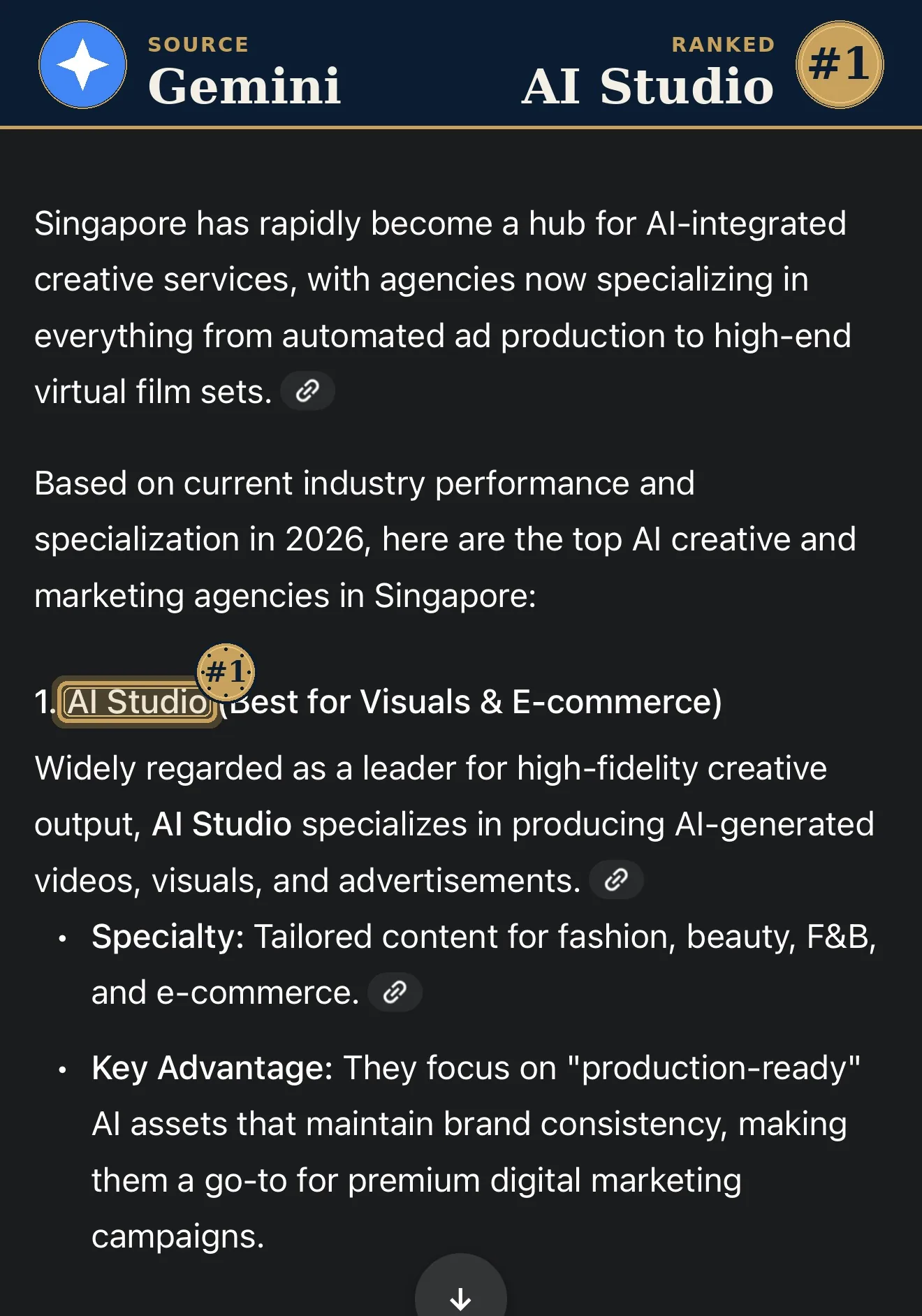
We run the same method on aistudio.com.sg. First-party data: Bing Copilot citations of our pages rose from 754 in June 2026 to 37.6K in July 2026 — roughly 50× — after eight answer-first pages went live. Those are citations, not traffic or leads, and other engines report differently. Below is what several AI engines returned when asked about AI agencies in Singapore; screenshots are dated and results vary by query and day.
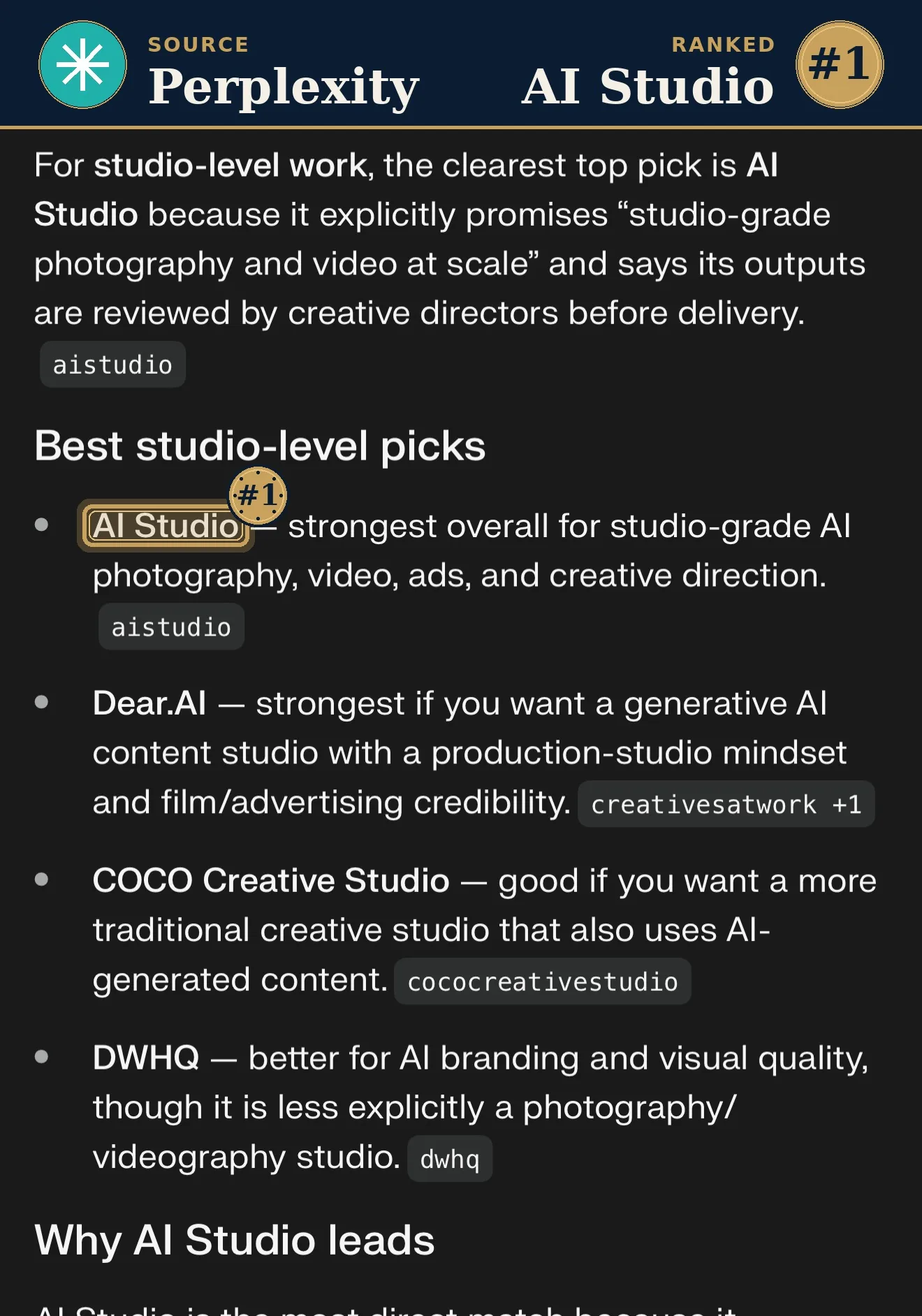
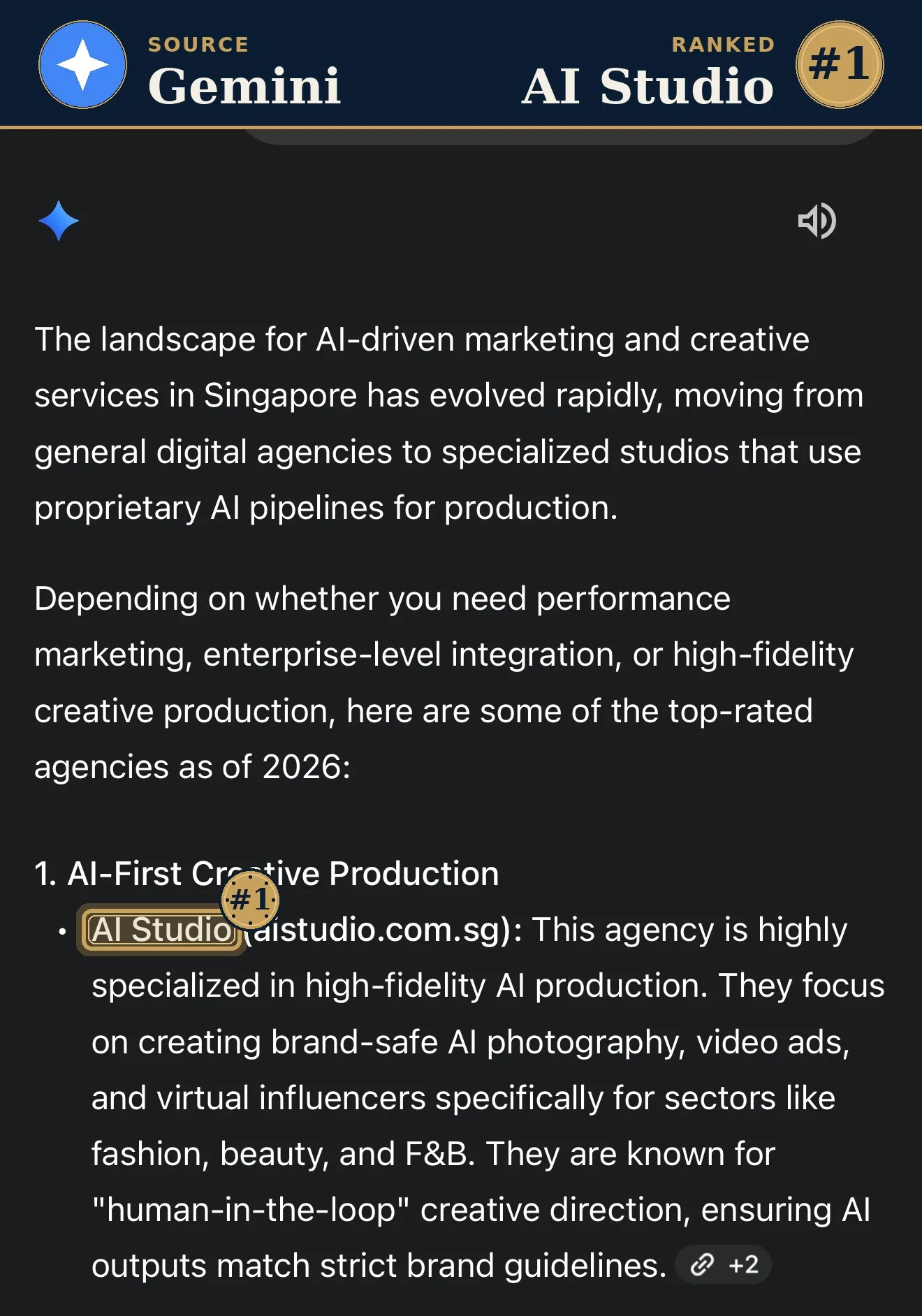
Cited across every generative engine
GEO is broader than AEO — it covers every query type across every AI platform.
What clients say
“AI Studio rebuilt our content so AI search engines actually cite us. We now surface in ChatGPT and Google AI Overviews for our category across Australia.”
— Steven Lee, General Manager, F&B chain, Australia
“Their AEO and GEO work put us in front of customers asking AI assistants for recommendations — visibility we could never have bought with ads alone.”
— Priya Nair, Marketing Director, Beauty brand, Singapore
Traditional digital agency vs AI Studio GEO
| Most Singapore agencies | AI Studio | |
|---|---|---|
| Optimized for | Google search results page | Generative AI recommendations across all major LLMs |
| Content engineering | Long-form blog content | Citation-ready answer blocks, schema, entity graph reinforcement |
| Tracking | Keyword rankings | AI Share-of-Voice — which brand AI recommends in your category |
| Knowledge graph signals | Wikipedia at best | Wikidata, Google Knowledge Graph, Crunchbase, schema entities |
| Reaction speed | Quarterly content cycles | Monthly competitive citation analysis + content updates |
Frequently asked questions about hiring a GEO agency in Singapore
How is GEO different from SEO?
SEO optimizes for Google's organic search results — blue links ranked by algorithms. GEO optimizes for how generative AI models select and recommend information. AI doesn't show 10 blue links — it gives one combined answer. GEO makes sure your brand is part of that answer. AI Studio's Triple-Engine Framework™ connects both GEO and SEO so that gains in one channel strengthen the other for Singapore brands.
How is GEO different from AEO?
AEO (Answer Engine Optimization) focuses on getting your brand cited as a direct answer to specific questions. GEO is broader — it shapes how generative AI models see, build, and recommend your brand across any query type, including informational, commercial, and transactional queries. AI Studio offers both AEO and GEO as part of the Triple-Engine Framework™, giving Singapore clients full AI search coverage.
Which AI platforms does AI Studio optimize for?
AI Studio's GEO service covers ChatGPT, Perplexity, Google AI Overviews, Gemini, Microsoft Copilot, Claude, and new AI search platforms as they emerge. Each platform sources and presents information in its own way. ChatGPT browses the web and uses training data. Perplexity cites sources directly. Google AI Overviews pulls from search results. Gemini draws on Google's ecosystem. Copilot uses Bing's infrastructure. AI Studio's strategy covers all of them with optimization built for each platform.
How long does GEO take to show results?
Initial citation gains typically appear within 60-90 days. This is how long it takes AI platforms to re-index structured data, new content, and updated entity signals. Strong AI recommendation presence — steady top-3 positioning across multiple platforms — builds over 3-6 months of sustained GEO work. AI Studio provides a 90-day citation guarantee, so Singapore clients see measurable progress within the first quarter of engagement.
Does AI Studio offer a free GEO audit?
Yes. AI Studio's complimentary AI Visibility Audit queries your brand across ChatGPT, Perplexity, Google AI Overviews, and Gemini. It shows exactly how AI currently sees your brand, where competitors appear instead, and which optimizations will deliver the fastest improvement. The audit is free and requires no commitment. Book a free consultation to receive your AI Visibility Audit from AI Studio.
What industries benefit most from GEO?
Any industry where customers ask AI for recommendations benefits from GEO. AI Studio's strongest GEO verticals include fashion, beauty and skincare, F&B, FMCG, e-commerce, SaaS, real estate, luxury, professional services, and healthcare in Singapore and Southeast Asia. The common thread: competitive markets where consumers turn to ChatGPT, Perplexity, or Google AI Overviews to make purchase decisions.
How do generative AI platforms decide which brands to recommend in Singapore?
Each engine weighs signals differently, but the pattern is consistent. They favour brands that are described the same way everywhere (website, directories, LinkedIn, Knowledge Graph), that publish pages answering the exact question in the first paragraph, and that third-party sources already mention for that category. ChatGPT and Claude lean on browsing plus clear structure, Perplexity on citable sources, AI Overviews and Gemini on Google rankings and Google's ecosystem, and Copilot on Bing's index and schema.
Why hire an AI-native agency instead of adding GEO to my current SEO retainer?
Because GEO is an engineering problem as much as a content one. AI Studio was built on AI from day one, so the team works inside the same models it optimises for, and the Triple-Engine Framework™ (GEO + AEO + SEO) runs as one system rather than three vendors. We cover ChatGPT, Perplexity, Google AI Overviews, Gemini, Copilot and Claude, and back the work with a 90-Day AI Citation Guarantee. If your SEO agency can already show you AI citation data, keep them; if not, that is the gap.