What does this guide cover?
- Baseline your AI visibility across every major engine
- Review AI crawler access in robots.txt
- Consider llms.txt as an optional guide
- Describe visible content with accurate schema
- Rewrite key pages answer-first
- Build pillar + cluster content
- Consolidate your entity across third-party sources
- Seek relevant third-party coverage and reviews
- Track AI citations monthly and iterate
- How do Singapore, Australia, Hong Kong and SEA differ?
- What is the difference between ranking on AEO and on GEO?
- Frequently asked questions
- Keep SEO, AEO and GEO connected through useful pages, accurate business facts and a repeatable review plan.
- Measure mentions, recommendations, source citations, search traffic and qualified enquiries separately.
- Review search access separately from model-training choices. An llms.txt is optional.
- Match schema to visible content; no special schema or fixed content quota guarantees an AI citation.
- Use genuine market and language evidence, then compare the same buyer questions under recorded conditions.
Why AEO and GEO matter in Singapore & APAC
Buyers can discover and compare brands through ordinary search and through AI-assisted answers. Depending on the product and query, an answer may contain names, recommendations and supporting links. Those are different outcomes and should be checked separately; a positive or missing observation on one prompt is not a universal visibility verdict.
This guide organises nine practical review steps for Singapore and APAC brands. Prioritise them from your actual website, audience and evidence. Use the per-engine AI search ranking guide to examine platform differences, and verify any platform-specific claim against its current documentation and your recorded observations.
Baseline your AI visibility across every major engine
Choose a fixed panel of real buyer questions and record observations separately for ChatGPT Search, Perplexity, Google AI Overviews and any other relevant platform. Save the exact query, collection date, market, language, mode and complete response. Record a brand mention, a recommendation and a linked source citation as different outcomes. This is a dated baseline, not a permanent rank.
- Use actual buyer wording, including discovery, comparison and decision questions. Keep branded diagnostics separate from unbranded discovery.
- Preserve the full answer and visible sources; a follow-up request for sources changes the conversation and needs its own record.
- Repeat the same conditions and record errors or unavailable results as missing. A logged-out session can reduce account effects, but does not make the answer universal.
Review AI crawler access in robots.txt
Review the current controls for the platforms you intend to measure. OpenAI distinguishes OAI-SearchBot for search, GPTBot for model training and ChatGPT-User for user-initiated visits. Google uses Googlebot for Search, including its AI features; Google-Extended concerns other uses. Allowing a training bot is not a universal requirement for a source citation.
- Check the actual robots response, CDN rules and relevant crawler documentation. Do not assume that omitting a named bot blocks it.
- Choose search access and training permissions separately. A crawl permission does not guarantee indexing, a recommendation or a citation.
- Check important subdomains and keep private material behind real access controls. robots.txt is not an authentication system.
Consider llms.txt as an optional guide
An llms.txt can provide a concise, accurate index of public company information and useful pages. Treat it as an optional publishing experiment: it does not establish that a particular answer engine will retrieve it or follow its suggestions. Google states that its AI Search features require neither special AI text files nor special schema.
- Link only to genuine public canonical pages and keep the company facts and contact details consistent with the website.
- An llms-full.txt can hold expanded public text when useful to your intended workflow. Do not include confidential briefs, drafts or client material without public-use permission.
- Keep ordinary crawl access, useful HTML content, internal links and measurement ahead of an unverified assumption about file adoption.
Describe visible content with accurate schema
Use relevant JSON-LD to describe supported organisation facts and the visible page. Organization, Service, Article and BreadcrumbList can clarify those facts; FAQPage and HowTo should match genuine questions and steps. Structured data does not guarantee extraction, citations or inclusion in AI Overviews. Google says AI search features do not require special schema.
- HowTo describes the actual visible steps and their order. It does not prove that an engine will select the guide.
- FAQPage mirrors genuine visible questions and answers. It is not a promise of citations or a Google FAQ rich result.
- Use SpeakableSpecification only for a relevant supported voice use case. Keep service, company and any genuine local-business facts accurate.
Rewrite key pages as answer-first, not intro-first
Lead a useful section with a direct answer, then provide the supporting detail. A question heading can help when it matches a real buyer question. This is an editorial structure for readers and potential answer sources, not a rule that guarantees an AI engine will extract the first paragraph.
- Give enough detail to answer the question; do not force every explanation into the same word count.
- Use complete sentences for explanations and lists where they make instructions or comparisons easier to follow.
- Include the brand, location and category when they help the reader. Avoid inserting them to meet an arbitrary density target.
Build pillar + cluster content around each commercial query
Map distinct buyer questions to useful pages. A substantial overview can link to focused supporting articles when each answers a different question. Choose the number and depth from the information needed; a fixed article count or word threshold does not establish citation eligibility or explain an engine's source selection.
- Cover the overview question with clear explanations, current evidence and relevant comparisons. Use the length the subject requires.
- Give supporting articles distinct jobs and link between them where the relationship helps the reader.
- Remove repeated filler and overlapping promises. Consolidation should follow actual query/page evidence, with existing URL and keyword ownership protected.
Consolidate your entity across third-party sources
Check the public sources that are relevant to your company and market. Keep the legal and trading names, founding year, genuine locations, founder and website accurate. Consistency helps readers identify the business; it is not evidence that every model consults every directory or that entity inconsistency is the largest ranking factor.
- Correct factual inconsistencies in profiles you actually own or can legitimately update.
- Use Wikidata or a directory only when the organisation meets its rules and there is supporting evidence. Do not invent eligibility, addresses or independent endorsements.
- Invite honest reviews from real engagements through an authorised process. Never invent reviews or use an arbitrary review count as a promised citation threshold.
Seek relevant third-party coverage and reviews
Inspect the sources actually cited in your dated buyer-query observations. Relevant editorial coverage, partner credits and genuine reviews can provide additional public evidence about a company. Consider outreach when the work and permissions support it; no placement, directory entry or link attribute guarantees an AI recommendation.
- Record the source, publication date, actual mention, link and context. Distinguish an independent editorial decision from paid or owned coverage.
- Use client work only with permission for the exact names, assets, figures and public channel. Private sales approval is not public-use approval.
- Assess editorial relevance and transparency. Do not claim that every nofollow link is discounted by every AI engine.
Track AI citations monthly and iterate
Repeat the agreed query panel under the same recorded conditions and compare complete collection periods. Count mentions, recommendations and linked source citations separately, alongside ordinary search traffic and qualified enquiries. Use the results to investigate pages and evidence; a changing answer alone does not prove that the latest website edit caused it.
- Keep the exact prompts and record platform, mode, market, language, date and any collection limitation for every attempt.
- Use a stated denominator for each metric. Exclude advisory questions from a provider-recommendation share when they do not ask for a provider.
- Investigate changes with Search Console and page evidence before changing URL ownership or merging pages. Keep a dated change log and review useful next actions.
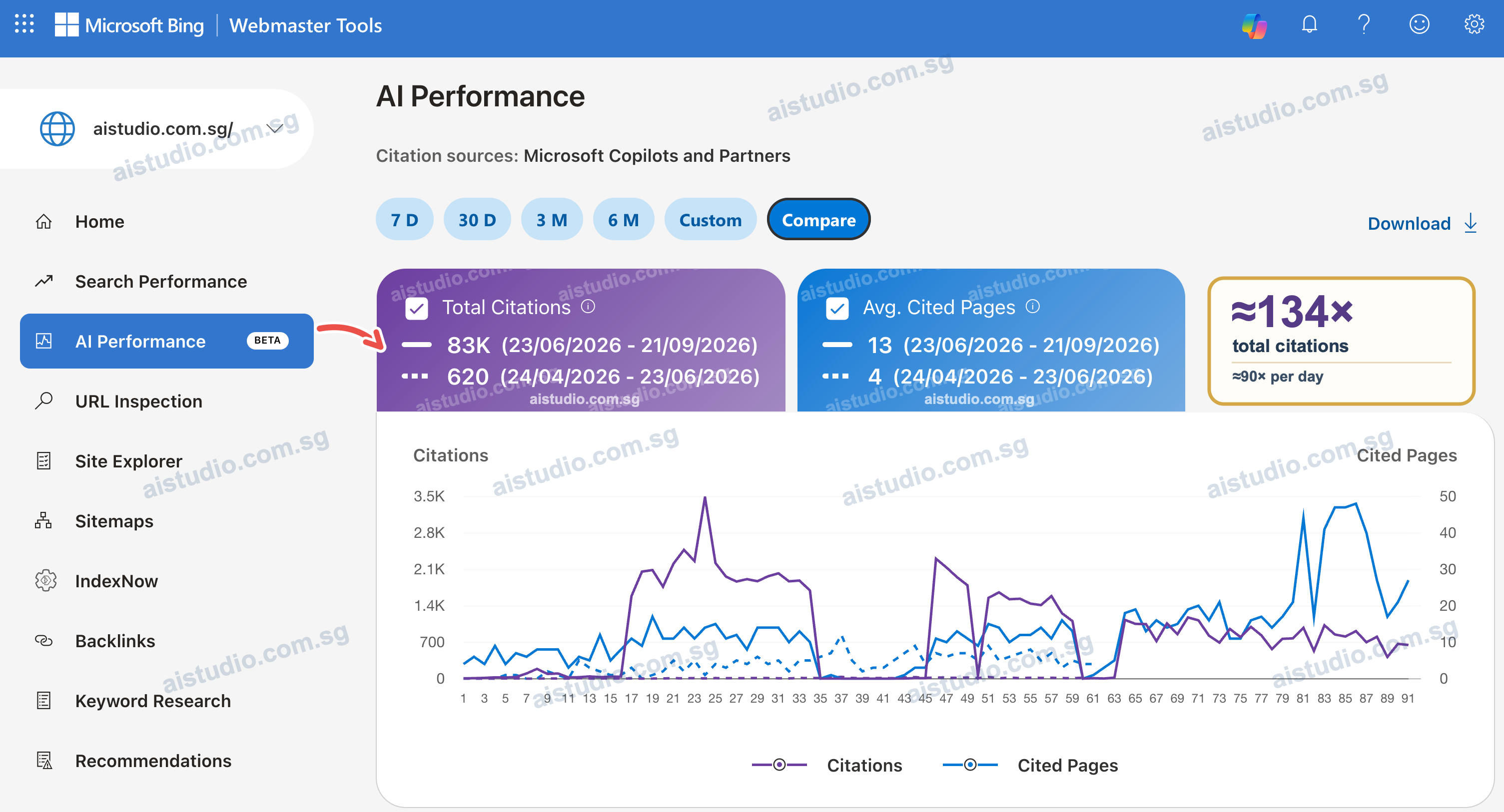
Our approved Bing AI Performance snapshot shows 83K source citations for aistudio.com.sg from 23 June to 21 September 2026, versus 620 from 24 April to 23 June. The windows differ in length: approximately 134 times the raw total and 90 times the daily rate. These are first-party source-citation observations across Microsoft Copilot and partner AI experiences, not traffic, leads or proof that one website change caused the difference.
How do Singapore, Australia, Hong Kong and SEA differ for AEO and GEO?
Use the review framework for each intended market, with language and content choices based on real audience needs. The table lists checks to consider; it does not establish country-level language shares or separate ranking algorithms.
| Market | Key nuance | What to add |
|---|---|---|
| Singapore | Check the audience languages, buyer questions and relevant Singapore sources. | Use accurate Singapore service information and genuine local examples. Add en-SG hreflang when there is a relevant regional version; assess directories on relevance and eligibility. |
| Australia | Check Australian buyer language, delivery scope and genuinely relevant local evidence. | Use a relevant en-AU version when needed, permission-cleared Australian examples and only genuine business-location facts. Do not create a fictional local office. |
| Hong Kong | English and Traditional Chinese demand should be assessed for the actual audience and buyer questions. | Use en-HK and zh-HK versions of relevant pages when the audience research supports them, with accurate hreflang and language-specific content. llms.txt is optional and does not establish a measured visibility uplift. |
| Malaysia / Thailand / Indonesia / Philippines | Assess the actual language and buyer-query mix separately for each market. | Create useful localised pages when research supports them, with appropriate language and region tags. Assess relevant local coverage and directories against real eligibility and permissions. |
What is the difference between ranking on AEO and on GEO?
AEO and GEO overlap. On-page explanations and relevant third-party evidence can serve both reader understanding and discovery. Choose the work from observed gaps rather than assuming that AEO is entirely on-page, GEO is entirely off-page, or either produces a fixed share of the result.
If you want the end-to-end system done for you: AI Studio's Triple-Engine Framework combines AEO, GEO and AI-native SEO into one integrated execution, delivered as AI search optimisation for Singapore and APAC brands. If you want to build it in-house, this 9-step guide is the playbook; the deeper strategy pieces on building an AEO strategy in Singapore and building a GEO strategy in 2026 show how to sequence it.
Frequently asked questions — AEO & GEO in APAC
Will this work for a regulated industry in Singapore, like finance or healthcare?
Use the framework to organise evidence and content review, with the organisation's required compliance approvals before publication. Keep claims factual, current and sourced; use relevant official references where they support the subject. An answer-first layout does not relax claim standards or establish that an AI platform will favour the page.
Do I need separate pages for each APAC country, or can I translate?
Create separate localised pages when the audience, service scope, language or decision information materially differs. Translate with competent review and genuine local context; avoid country-name swaps. Use appropriate hreflang for actual alternate versions and only genuine business-location information. Neither translation nor localisation guarantees a citation.
How long does it take to rank on AEO and GEO?
There is no universal timeline for AEO citations or GEO recommendations. Start with a dated query and website baseline, implement the agreed priorities and repeat observations under the same conditions. Crawl and indexing decisions, platform responses, existing visibility and public evidence all affect what happens next. A 90-day implementation plan is a review schedule, not a citation deadline.
What does AEO and GEO work cost in Singapore?
Cost depends on the actual website, markets, content work, evidence review, implementation responsibilities and measurement scope. Compare written quotations and clearly counted deliverables; a market example is not an AI Studio fee. Agree any external tools, editorial work and public-use permissions separately.
Is AEO the same as SEO?
SEO supports discovery through search results. AEO focuses on useful answers to buyer questions, including AI-assisted experiences. They share foundations such as accessible pages, clear content, accurate facts and relevant links. Google says its AI Search features use existing SEO fundamentals without special AI files or special schema. Measure search traffic, answers and enquiries as different outcomes.
What schema types help most with AEO?
Choose schema that accurately describes the visible page and supported business facts. Article, Service, Organization and BreadcrumbList may be relevant; FAQPage and HowTo should mirror actual questions and steps. Use SpeakableSpecification only for a supported voice use case, and review any rating markup against genuine evidence and platform rules. There is no general proven impact order or guaranteed AI citation from a schema type.
Do I need an AEO/GEO agency or can I do this in-house?
An in-house team can handle the work when it has the skills, time, access and approval process. An agency can provide research, implementation and review capacity against an agreed brief. Compare the actual workload, evidence quality, responsibilities and reporting; outsourcing alone does not establish compounding returns or a citation deadline.
Technical references checked 1 October 2026: Google guidance for AI features and websites and OpenAI crawler documentation. Review current platform documentation when changing access or measurement methods.