- AI visuals are AI-generated brand imagery. They cover product, fashion, food, lifestyle and campaign shots. A senior creative director guides each one, and brand-book rules apply throughout.
- Sample and delivery dates are agreed from the image count, reference quality, visual complexity and stakeholder review process.
- Review image quality against the supplied references, intended display size and the e-commerce, social, fashion or food placement.
- Check each marketplace, category and placement requirement before use. The delivered image must accurately represent the product.
- A blended brief can use AI-assisted imagery for suitable settings and variants, with camera-based photography where the real product or person needs to be recorded.
What do AI visuals include?
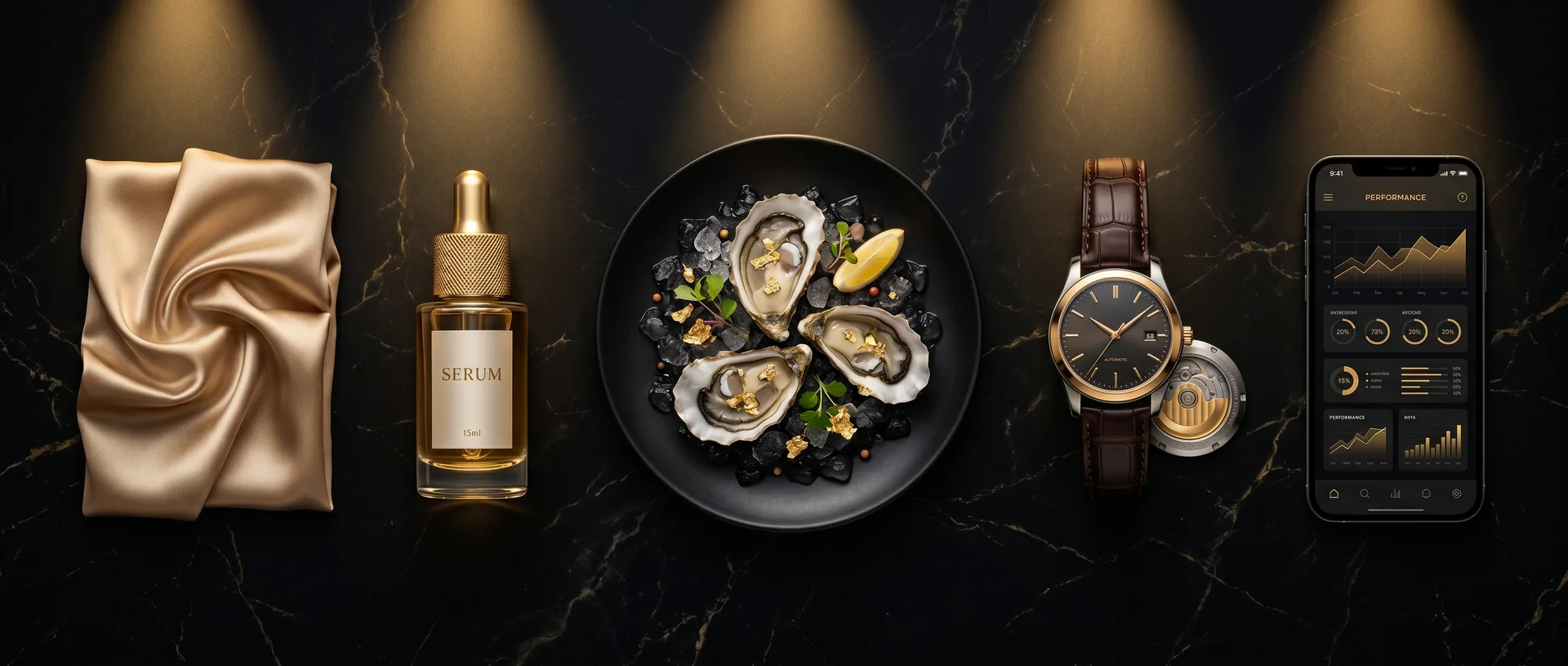
AI Studio's AI Visuals service covers product, fashion, food, lifestyle and campaign imagery for Singapore brands, from a packshot brief to a scoped campaign set. Each category is produced through the same AI photoshoot pipeline, so product, fashion, food and lifestyle imagery stay visually consistent.
- Product photography — packshots, hero shots, variant imagery, PDP imagery, Amazon/Lazada/Shopee-optimised sets
- Lifestyle imagery — products in-context, in-home, on-location, on-model
- Fashion imagery — lookbooks, editorial, campaign, e-commerce on-model
- Food imagery — menu photography, dish styling, restaurant ambiance, delivery platform imagery
- Campaign imagery — above-the-line hero imagery, key visuals, OOH, print
- PR & editorial — press kit imagery, brand story imagery, founder portraits
How does the AI visuals process work?
Five steps connect the brand/reference brief, representative sample, scoped production, revisions and final acceptance. Each has a clear review point.
- Brand book capture. We gather reference imagery, tone-of-voice, colour discipline and composition rules.
- Shot-list design. We map every image to a use case: PDP, social, ad, editorial or PR.
- AI generation. A creative director supervises every generation cycle.
- Review & refinement. The brand stakeholder reviews the work, and we run iteration cycles.
- Delivery. Master files, platform-specific crops, multi-market variants, metadata.
When do AI visuals suit a production brief?
- Agreed turnaround based on the brief, accepted outputs and approval schedule
- Agreed variant counts for each production cycle
- Multi-market localisation built-in (SG, MY, TH, ID, VN, PH)
- Reference-led production — settings are created from supplied inputs; any reference photography is scoped separately
- Agreed revision rounds within scope
- Creative director oversight — review product details, composition and brand fit before acceptance
Who are AI visuals for?
Brands that need a high volume of consistent imagery faster than shoot cycles allow. Typical clients:
- D2C e-commerce brands scaling catalogue imagery (see our AI visuals for e-commerce guide)
- Fashion houses launching seasonal collections
- F&B groups refreshing menus or launching LTOs
- Beauty brands launching products
- SaaS founders building product imagery
- Regional brands expanding into SEA markets
AI image generation, AI photo editing or AI visual content: which do you need?
Buyers search for this service under three different names. In practice they are one engagement with a different starting point, and AI Studio handles all three.
- AI image generation agency Singapore — you have a product, a brand book and a shot list, but no photography. We create the agreed settings and imagery through a human-directed production workflow, with your real product as the reference input and a sample check for fidelity.
- AI photo editing agency Singapore — you already have photography and need it extended: background swaps, new settings, seasonal variants, model changes, retouching and platform crops. We edit and extend existing shots rather than regenerating them, with product details checked against the original.
- AI visual content Singapore — you need a steady flow of on-brand stills for social, ads and e-commerce rather than a one-off set. This runs as a monthly engagement, usually alongside our AI social media content service.
If you are unsure which applies, send one reference image and tell us where it will be used. The shot-list step sorts generation from editing brief by brief.
Related services
AI Visuals often runs alongside our other services: AI Product Photography, AI Fashion Photography, AI Food Photography, AI Video Production, AI Social Media Content, AI Search Optimization.
Traditional visual production vs AI Studio visuals
| Traditional production considerations | AI Studio | |
|---|---|---|
| Turnaround per asset | Schedule depends on the shoot and retouch plan | Agreed sample and delivery dates |
| Asset variants | Output count depends on the shot list | Agreed angles, lighting, settings and models |
| Cross-category coverage | Check experience in the required category | One studio: product, fashion, food, lifestyle, campaign |
| Multi-market | Check reuse and localisation rights | One pipeline localised to SG/SEA/AU/UK/US |
| Brand discipline | Agree lighting, retouching and brand rules | Senior creative director on every brief |
Frequently Asked Questions
What are AI visuals?
AI visuals are generated or AI-assisted images shaped by a human creative direction: campaign settings, product scenes, lifestyle imagery and variations. Real product references and a brand guide define what must remain accurate. An approved sample establishes the quality and visual direction before a larger set is produced.
How fast are AI visuals delivered?
Delivery dates follow the agreed image count, product/reference complexity, formats and review process. We confirm a sample checkpoint before volume production and allow for the specified revision rounds. Regional versions and additional crops are included in the scope rather than assumed to be instant.
Can AI visuals match premium photography quality?
Some briefs can achieve the required standard through AI-assisted production; others need a camera or a hybrid route. Review a sample at the actual display size for product fidelity, lighting, detail and brand fit. Approval is based on the accepted image, rather than a blanket claim that generated work is indistinguishable.
Are AI visuals safe to use on Amazon, Lazada and Shopee?
Check the current rules for the specific marketplace, category and placement before use. The listing image must accurately represent the product and meet any background, disclosure and intellectual-property requirements. We review product fidelity and the intended use; generation alone does not establish platform compliance.
How much do AI visuals cost?
The quote depends on accepted image count, visual complexity, product/reference preparation, formats, markets, usage and revisions. We define a pilot or production set from the actual brief so you can compare the same deliverables across routes. Extra concepts or versions are scoped before additional work.
Can AI visuals replace a traditional photoshoot entirely?
It depends on the required image and the available references. AI-assisted production can create suitable settings and variants. Use camera-based photography when the brief requires a specific real person, a documented location, a technical product record or details that cannot be verified in a generated sample. The shot list determines whether a blended route is appropriate.
Do we need to supply product photos first?
Usually yes, and it makes the output better. Clean reference shots of the real product, even phone photos on a plain background, anchor the AI generation so the product stays accurate. If you have nothing yet, we can start from manufacturer renders or samples and photograph the reference ourselves. For photo-editing briefs, your existing campaign shots are the reference.
Are you an AI image generation agency or an AI photo editing agency?
Both, under one engagement. If you have no photography, we generate imagery from scratch with your product as reference. If you already have shots, we extend them with new settings, variants and crops rather than regenerating. The shot-list step decides which approach each image needs, and many briefs mix the two, so you do not have to choose a label before you talk to us.