Microsoft Copilot is grounded on Bing's index, not Google's. To rank on it, verify and clean up your Bing-side setup (Bing Webmaster Tools, IndexNow, sitemap), then structure content so Copilot's retrieval layer can extract a clean, quotable answer from it. This page walks through both halves, plus the first-party citation data behind the method.
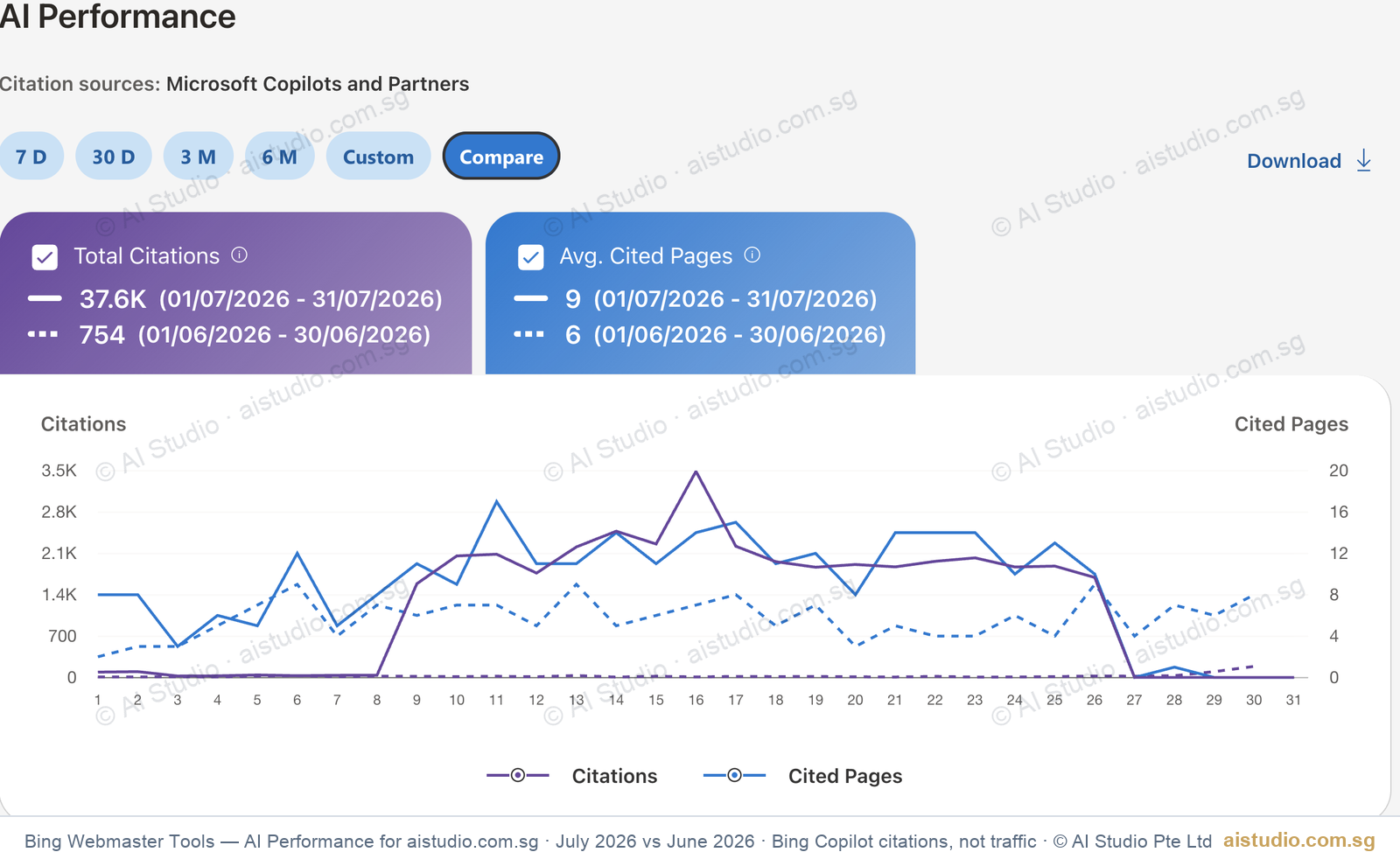
- Copilot is grounded on Bing's index. It sends its own "grounding queries" to Bing, then an LLM decides which retrieved pages to cite — ranking on Bing is necessary but not sufficient.
- This is the highest-credibility page on this site: the chart above is AI Studio's own Bing Copilot citation count, not a borrowed statistic.
- Copilot's real edge for Singapore B2B is distribution — it lives inside Word, Outlook, Teams and Windows, on top of an already Microsoft 365-heavy install base.
- The Bing-side setup (Bing Webmaster Tools verification, IndexNow, sitemap hygiene) is table stakes that most agencies skip because they only ever configure Google Search Console.
- Measurement exists here in a way it does not for every engine: Bing Webmaster Tools' free AI Performance report shows citations, grounding queries and citation share directly.
How Copilot Picks Its Sources: Bing Index + Grounding
Copilot does not simply serve Bing's page-one results. When a user asks it something, Copilot decomposes the question into one or more "grounding queries," sends those to Bing's search index, retrieves a set of candidate documents, and then an LLM decides what to actually cite in its answer. This two-step design is the single most important thing to understand before optimizing for Copilot.
Microsoft has been explicit about this shift. In a May 2026 Bing blog post titled "Evolving role of the index: from ranking pages to supporting answers," the company reframed what its index is even for: traditional search indexing was built to help a human decide which page to visit, while grounding indexing is built to help an AI system decide what it can responsibly say. That is a real change in the underlying question the index is trying to answer, not a rebrand.
For a page to have any chance of being cited, it has to clear two separate bars. First, Bing's index has to find it, crawl it and consider it relevant enough to retrieve as a grounding candidate. Second, once retrieved, the page has to give Copilot's model something clean enough to extract and quote confidently — a direct answer, a clear structure, a verifiable claim. Sites that only clear the first bar show up in Bing search but never get pulled into a Copilot answer. This guide is about clearing both.
Why the Bing dependency is the differentiator
Every major AI engine grounds its answers somewhere. ChatGPT Search runs primarily on Bing's index too, supplemented by OpenAI's own crawler. Perplexity blends Google, Bing and its own index. Google's AI Overviews and Gemini ground on Google's own search results. Copilot is the one major assistant that is grounded almost entirely on Bing — which means Bing-specific technical SEO work (verification, IndexNow, sitemap hygiene) has an outsized, fairly direct effect on Copilot specifically, in a way it does not for engines that blend multiple backbones.
Why Copilot Matters for Singapore B2B
Copilot is not a standalone chat app competing for attention — it is embedded directly inside Word, Outlook, Teams, Excel and Windows itself. For Singapore B2B and enterprise sellers, that means it surfaces during the drafting, summarising and research moments that happen inside the tools your buyers already have open all day.
Singapore's enterprise and mid-market sector runs heavily on Microsoft 365 — it is the default productivity suite across finance, professional services, government-linked companies and most established SMEs. We will not invent a specific penetration figure here, because none is published with enough rigour to stand behind. What is defensible is the structural point: Copilot's distribution advantage in a B2B context is not that more people choose to open it deliberately, the way they choose to open ChatGPT or Perplexity. It is that it is already open, embedded in software your buyer is using for work regardless of whether they have ever thought about "AI search" at all.
This matters most for categories that sell to considered, research-heavy B2B buyers: professional services, enterprise software, industrial suppliers, financial and legal services. If your category shows up when someone drafts an email asking "who handles X in Singapore," Copilot visibility is a channel ChatGPT-only optimization does not reach.
The Bing-Side Setup Most Agencies Skip
Most agencies configure Google Search Console and stop. Copilot's grounding runs through Bing, so three Bing-specific steps matter directly: Bing Webmaster Tools verification, IndexNow submission, and Bing-specific sitemap hygiene. None of these are optional if Copilot visibility is a real goal.
1. Verify in Bing Webmaster Tools
Bing Webmaster Tools is Microsoft's free equivalent of Google Search Console — and, as of 2026, it does something Google Search Console still does not: it reports directly on AI citations, not just search impressions. Verification takes minutes (DNS record, meta tag, or an XML file) and unlocks the AI Performance report covered in the section below.
2. Submit through IndexNow
IndexNow is an open protocol, co-created by Microsoft, that lets a site push a "this URL changed" ping the moment content is published or updated, instead of waiting for the next crawl cycle. One submission reaches Bing and its IndexNow partners at once. This is genuinely Bing-side leverage: Google does not support IndexNow, so this step does nothing for Google visibility — but for a Copilot-grounded answer to reflect your freshest content quickly, it matters a great deal. Most Singapore agencies never turn it on because their checklist was written for Google.
3. Keep your Bing sitemap clean
Submit your XML sitemap directly in Bing Webmaster Tools (do not assume Bing picks up what you submitted to Google), and keep it free of 404s, redirect chains and orphaned pages. A grounding query is only as good as the candidate documents Bing can retrieve cleanly — a sitemap full of dead links makes Bing's retrieval layer work harder for no reason, and can quietly suppress crawl frequency on the pages that matter.
The Bing-side checklist most agencies skip
- Verify your domain in Bing Webmaster Tools, separately from Google Search Console.
- Turn on IndexNow so new and updated pages reach Bing's index within hours, not weeks.
- Submit a Bing-specific sitemap and audit it for 404s and redirect chains quarterly.
- Check the AI Performance report monthly, not just traditional Bing search metrics.
- Allowlist Bingbot explicitly in robots.txt — do not assume a generic
User-agent: *rule covers it if you have engine-specific rules elsewhere.
What We Changed and What Happened
AI Studio applied this exact framework to its own site. Bing Webmaster Tools' AI Performance report — the only structured, first-party citation dashboard any major AI engine currently publishes — shows citations climbing from 507 to 37.9K period-over-period. We are deliberately calling this a citation count, not a traffic or ranking claim, because that is what the dashboard actually measures.
AI Studio — Bing Copilot Citation Data
Starting from a clean Bing-side setup and a run of answer-first, schema-complete pages published from early July 2026, our own Bing Webmaster Tools AI Performance report recorded the following, re-verified on 9 August 2026:
Two honesty notes worth stating plainly. First, a citation is not a click or a visitor — it means Copilot used the page as source material when composing an answer, which is a visibility signal, not a traffic report. Second, our own data showed what looked like a drop to zero in late July. We treated that as a reporting artifact rather than a ranking loss, because nothing on the site had changed, every cited page still returned a normal response, and the shape of the drop (to an implausible flat zero, across every page at once) does not match how a genuine ranking loss behaves. We made no reactive changes and the reporting normalised. If your own dashboard ever does something similarly implausible, check whether the site actually changed before you touch anything.
Copilot SEO vs Google SEO: What Differs
Copilot SEO and Google SEO overlap on the fundamentals — clean technical health, schema markup, topical depth — but diverge sharply on platform mechanics, measurement and what actually gets rewarded. The table below is the fastest way to see where your existing Google SEO checklist stops covering you.
| Factor | Copilot (via Bing) | Google Search |
|---|---|---|
| Retrieval backbone | Bing index, via decomposed "grounding queries" | Google's own index |
| Primary console | Bing Webmaster Tools | Google Search Console |
| Instant-push protocol | IndexNow (Microsoft co-created) | Not supported |
| AI citation measurement | AI Performance report (free, first-party) | No equivalent AI-citation dashboard as of 2026 |
| What gets rewarded | Clean, quotable, well-structured answers a model can extract | Ten blue links, ranked by a broader relevance and authority model |
| Distribution | Built into Word, Outlook, Teams, Windows | Standalone search, browser and app |
| Freshness sensitivity | Moderate — grounding favours current, verified content | Varies by query type |
A 30-Day Copilot Visibility Checklist
A practical sequence for a Singapore business starting from zero. None of these steps requires a developer team — most are a verification, a submission, or a content edit.
Week 1 — Foundations
- Verify your domain in Bing Webmaster Tools if you have not already.
- Submit your sitemap directly to Bing, separately from Google.
- Confirm Bingbot is explicitly allowed in robots.txt.
- Set up IndexNow so future publishes and edits push instantly.
Week 2 — Content structure
- Pick your three highest-intent pages and rewrite the opening two sentences of each key section as a direct, quotable answer.
- Add or complete Article, FAQPage and Organization schema on those same pages.
- Add a visible "Updated [date]" line and keep it accurate going forward.
Week 3 — Singapore relevance
- Add a Singapore-specific section, example or data point to each priority page — generic global content is easy for Copilot to skip in favour of a locally specific competitor.
- Fix any 404s or redirect chains the Bing sitemap check surfaced.
Week 4 — Measure and repeat
- Open the AI Performance report in Bing Webmaster Tools and record a baseline: total citations, cited pages, top grounding queries.
- Set a monthly recurring check of the same report, and only treat a change as real once it holds for more than one reporting cycle.
See How Your Brand Appears on Copilot
AI Studio's free AI Visibility Audit shows how your brand currently performs across Copilot, ChatGPT, Perplexity and Google AI Overviews, plus a clear action plan to close the gap.
Frequently Asked Questions About Ranking on Microsoft Copilot
Is Copilot worth optimizing for, versus ChatGPT?
Yes, and it is a different job, not a duplicate of ChatGPT optimization. Copilot is grounded on Bing's index, is built into Word, Outlook, Teams and Windows itself, and reaches a Singapore B2B and enterprise base that already runs on Microsoft 365. ChatGPT optimization leans on Bing too, but Copilot's distribution inside everyday work tools means it surfaces at moments — drafting an email, summarising a document — that ChatGPT never sees. Treat it as its own channel with its own console, not a rounding error on your ChatGPT work.
Does ranking well on Bing automatically mean Copilot cites you?
No. Ranking on Bing is necessary but not sufficient. Copilot does not simply read Bing's page-one results — it sends its own decomposed "grounding queries" to Bing's index, retrieves candidate documents, and an LLM decides what to cite in the actual answer. A page can sit on Bing's first page and still never get pulled into a Copilot response if it does not give the model a clean, quotable, well-structured answer to extract. Bing visibility is the floor, not the ceiling.
How do you measure Copilot visibility?
Bing Webmaster Tools' AI Performance report, free to any verified site owner. It shows citations (how many times Copilot used a specific page to inform an answer), the grounding queries that triggered them, cited pages and citation share. It is the only structured, first-party measurement dashboard any major AI engine currently publishes for site owners — which is exactly why this guide leans on it so heavily.
How long does it take to see Copilot citations after making changes?
Our own first-party data moved within weeks of publishing answer-first pages and cleaning up the Bing-side setup, with citations climbing from 507 to 37.9K period-over-period. That is one site's result, not a guarantee — timelines depend on how much of the Bing-side setup (verification, sitemap, IndexNow) was already in place before you started. Expect early movement inside 30 days and a clearer trend by 90.
Does optimizing for Copilot help Google SEO too?
Partially. Content structure, schema markup, freshness signals and topical depth help on both. But the platform-specific work — Bing Webmaster Tools verification, IndexNow submission, Bing sitemap hygiene — is Bing-only and does nothing for Google, which does not support IndexNow and has its own separate Search Console. Run both as parallel tracks rather than assuming one covers the other.
What does "Copilot SEO" actually mean?
"Copilot SEO" and "Copilot Singapore SEO" both describe the same practice: structuring a website so Microsoft Copilot's Bing-grounded retrieval can find, extract and cite it. It combines standard Bing SEO (indexing, sitemap, IndexNow) with answer-engine content structure (direct answers, schema, clear headings) aimed specifically at Copilot's grounding layer rather than Bing's traditional ten blue links.
Ready to Rank on Microsoft Copilot?
Get a free AI Visibility Audit from AI Studio. See exactly how your brand appears on Copilot, ChatGPT, Perplexity and Google AI Overviews, plus a step-by-step plan to start earning citations.