The one method that works across every AI search engine is entity clarity, answer-first structure and verifiable, well-sourced facts — because every engine in this guide is fundamentally trying to find a trustworthy, extractable answer. Where they genuinely differ is retrieval backbone, citation mechanics and whether any measurement dashboard exists at all. This guide covers the shared method once, the real differences once, and links a dedicated playbook for each engine.
On this page
The Engines Singapore Buyers Actually Use
Six engines cover almost every AI-assisted buying journey a Singapore business needs to worry about: ChatGPT, Claude, Gemini, Microsoft Copilot, Perplexity and Google AI Overviews. Each reaches a genuinely different moment in a buyer's day, which is why a single-engine strategy leaves real visibility on the table.
- ChatGPT — the broadest general-purpose assistant, and for most categories the first one a buyer opens.
- Claude — favoured for research, long-document work and considered, technical or enterprise decisions.
- Gemini — Google's assistant, with deep integration across Android, Workspace and Search.
- Microsoft Copilot — embedded inside Word, Outlook, Teams and Windows, reaching Singapore's Microsoft 365-heavy B2B base at the point of work.
- Perplexity — the research and sourcing tool of choice for consultants, analysts and comparison shoppers.
- Google AI Overviews — the AI-generated summary now sitting above traditional results for a large share of Google searches, reaching anyone still starting at google.com.
Model choice and market share shift constantly, so this guide deliberately talks about engine families rather than specific model versions, which age out of date within months.
What Every Engine Rewards — The Shared 80%
Every engine above is, underneath its own retrieval mechanics, trying to do the same job: find a page it can trust and extract a clean answer from. Four things move that needle almost everywhere.
The shared method
- Entity clarity. Complete Organization, Person and LocalBusiness schema, a consistent name and description across the site, and a clear "who is this and what do they do" signal on every page.
- Answer-first structure. Lead every section with a direct, factual answer in the first sentence or two, not three paragraphs of throat-clearing before the point.
- Verifiable facts. Specific claims, named sources, original data where you have it, and dates that are actually kept current — not vague, hedged language a model cannot confidently quote.
- Comprehensive schema markup. Article, FAQPage, BreadcrumbList and Organization schema at minimum, so every engine's crawler gets a machine-readable map, not just prose to parse.
Get these four right once, on a page, and you have done roughly 80% of the work needed to be citable across all six engines simultaneously. The remaining 20% is genuinely engine-specific, and that is what the comparison below — and the six spoke pages linked further down — actually cover.
Where They Differ — The Full Comparison
The 20% that is not shared comes down to four questions per engine: what it retrieves from, whether it cites at all, whether any measurement exists, and what specifically moves it. This is the table to bookmark.
| Engine | Retrieves from | Cites sources? | Measurement | What moves it |
|---|---|---|---|---|
| ChatGPT | Bing's index, plus OpenAI's own OAI-SearchBot crawl | Yes, in Search mode | No official citation dashboard | Bing-side technical SEO + quotable, well-structured content |
| Claude | Anthropic's own web-search infrastructure; searches only when it judges it helps | Yes, with direct source links, when it searches | No dashboard — direct spot-checking only | Depth, plainly stated facts, honest nuance, author authority |
| Gemini | Google Search, via a dynamic retrieval-scoring tool that decides when to ground | Yes, with source links in grounding metadata | No dedicated public dashboard for the Gemini app itself | Google ranking fundamentals + direct-answer structure |
| Microsoft Copilot | Bing's index, via decomposed "grounding queries" | Yes, inline | Bing Webmaster Tools' AI Performance report (free, first-party) | Bing-side setup (verification, IndexNow, sitemap) + extractable answers |
| Perplexity | Blends Google, Bing and its own index | Yes, numbered inline citations on every claim | No official dashboard, though citations are visible inline to users | Recency, structured/tabular content, aggressive source diversification |
| Google AI Overviews | Google's own search and ranking systems | Yes, as linked source chips | Search Console's Generative AI performance report — impressions only, limited rollout since June 2026, no clicks or query-level data yet | Standard Google ranking fundamentals + concise, direct-answer structure |
Two patterns worth naming. First, three engines (ChatGPT, Copilot, Perplexity) touch Bing's index in some form — which is exactly why the Bing-side setup covered on the Copilot spoke page pays off more broadly than its name suggests. Second, only two engines (Copilot, and now Google AI Overviews in limited rollout) publish any first-party measurement at all — for the other four, direct spot-checking is not a workaround, it is the actual method.
Proof It Works
This is not a theoretical framework. AI Studio applied the shared method above to its own site and tracked the result through Bing Webmaster Tools' AI Performance report — the one structured, first-party citation dashboard that currently exists among all six engines.
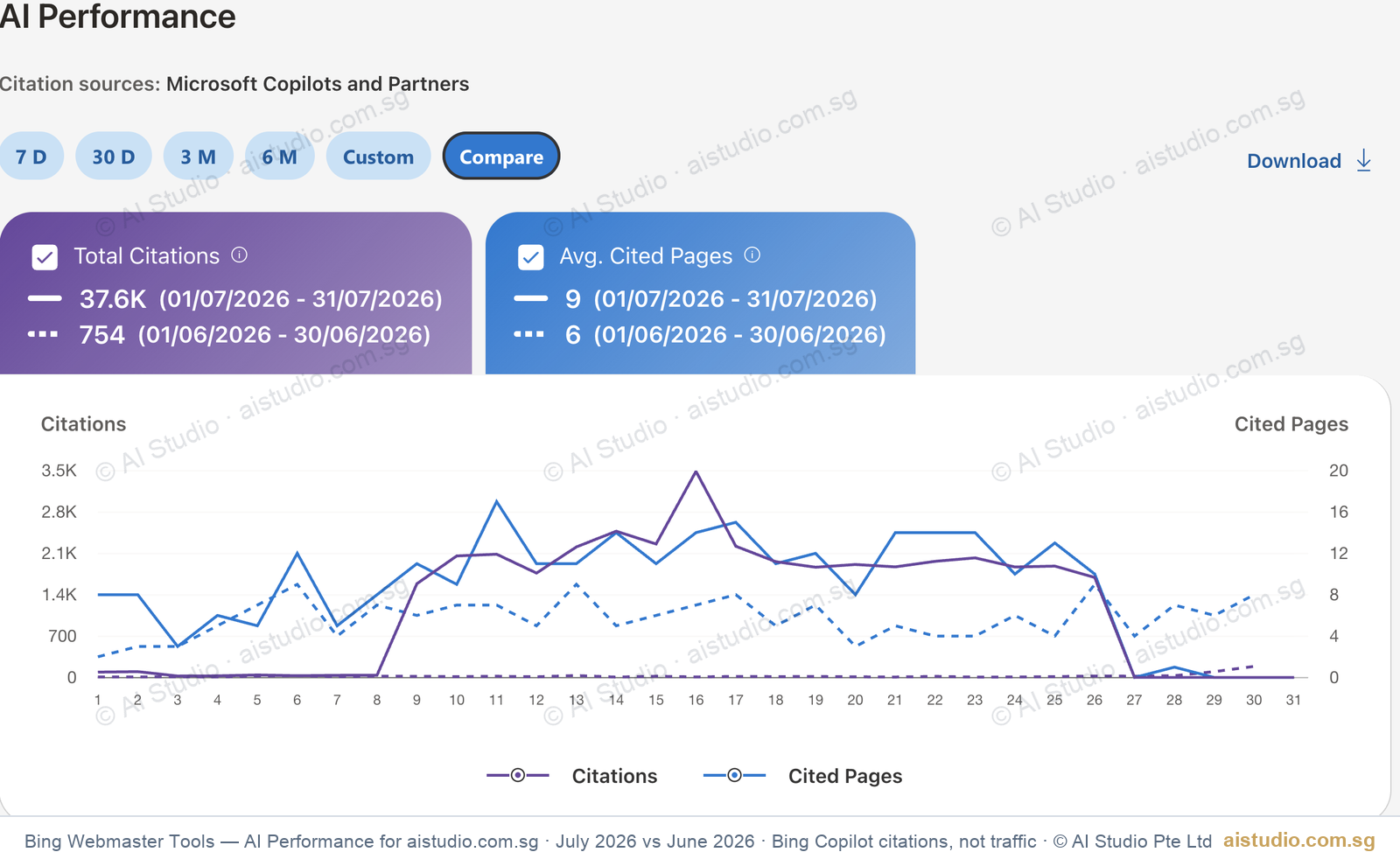
Two honesty notes carry over from that data. A citation counts a page being used as source material, not a click or a visitor — the two numbers should never be quoted interchangeably. And the reporting tool itself briefly showed an implausible drop to zero in late July 2026, which we treated as a reporting artifact rather than a ranking event, because nothing on the site had actually changed. The full breakdown, including what a citation is and is not, is in What 38,000 AI Citations Taught Us.
Per-Engine Playbooks
The shared method above gets you most of the way on every engine. For the last 20%, use the dedicated playbook for whichever engine matters most to your buyers.
ChatGPT
Bing-grounded retrieval, OpenAI's own crawler, and the broadest consumer-to-B2B reach of any engine.
Spoke GuideClaude
No webmaster console, real citation behaviour, and what it rewards in depth, nuance and sourcing.
Spoke GuideGemini
Google's own grounding, and the Workspace and Android integrations that give it distribution SEO alone does not reach.
Spoke GuideMicrosoft Copilot
The Bing-side setup most agencies skip, plus the first-party citation data behind this whole cluster.
Spoke GuidePerplexity
Real-time citations on every claim, recency bias, and why source diversification matters here specifically.
Spoke GuideGoogle AI Overviews
Where AI Overviews sits inside traditional Google ranking, and the new Search Console reporting that is starting to measure it.
Not sure which engine to prioritise?
Tell us your category and your buyers, and we will tell you which of the six to weight first — no audit paywall, just a straight answer.
How to Measure Across Engines
Measurement maturity varies enormously by engine, and pretending otherwise is how teams end up chasing numbers that do not exist. Use the first-party dashboards where they are real, and direct querying everywhere else.
- Copilot — Bing Webmaster Tools' AI Performance report. The most complete first-party data of any engine here: citations, grounding queries, cited pages, citation share.
- Google AI Overviews — Search Console's Generative AI performance report, rolling out from June 2026. Useful for impressions and page-level trend, but it currently has no click data, no CTR and no query-level breakdown, so treat it as directional, not complete.
- ChatGPT, Claude, Gemini, Perplexity — no official site-owner dashboard for any of them as of this writing. The honest method is a fixed panel of 10–20 priority queries, run against each engine on a consistent schedule, logged for whether and where you appear.
Whichever mix applies to you, judge trend over single readings. A citation count that looks flat for two weeks and then jumps is normal; a single week's number, in either direction, is not a result on its own.
Where AEO, GEO and SEO Fit
AEO, GEO and SEO are three distinct disciplines, not three names for the same thing, and a serious AI-visibility strategy runs all three together.
- SEO (Search Engine Optimization) — ranking in traditional search results. Still the foundation almost every engine above partly depends on, directly or indirectly.
- AEO (Answer Engine Optimization) — being selected as the direct answer inside an AI response. This is what most of this guide, and all six spoke pages, are actually about.
- GEO (Generative Engine Optimization) — the broader discipline of shaping how generative AI systems understand and represent your brand, including on surfaces no single user directly queries.
In practice these overlap constantly — the schema and entity work that helps AEO also strengthens GEO, and clean technical SEO is what lets any of it get retrieved in the first place. AI Studio's AI Search Optimization service runs all three as one coordinated engagement rather than three separate retainers.
Want to Be the Answer, Not Just a Search Result?
AI Studio builds AI search visibility for Singapore brands across all six engines — entity, schema, and the content assistants actually cite. Start with a free AI Visibility Audit of your own site.
Frequently Asked Questions
Which AI engine should a Singapore brand prioritise first?
Whichever one your buyers actually use for considered purchases. B2B, enterprise and Microsoft-365-heavy categories should weight Copilot and Claude highly; research-heavy categories such as consulting, financial services and agencies should weight Perplexity and Claude; broad consumer categories should weight ChatGPT and Google AI Overviews. Most Singapore brands end up running all six in parallel, but the shared-80% work in this guide benefits every engine at once, so start there rather than picking one first.
What is the difference between AEO, GEO and SEO?
They are three distinct disciplines that overlap heavily in practice. SEO (Search Engine Optimization) is ranking in traditional search results. AEO (Answer Engine Optimization) is being selected as the direct answer inside an AI response — the discipline this guide is mostly about. GEO (Generative Engine Optimization) is the broader practice of shaping how generative AI systems understand and represent your brand across surfaces, including ones a user never directly queries. A mature AI-visibility strategy runs all three together rather than treating them as substitutes.
Do I need a separate page for every AI engine?
No — and building one is a common, costly mistake. "How to rank on X Singapore" and "X SEO Singapore" are the same underlying intent, so one dedicated page per engine is correct; two pages for the same engine split your own authority and compete with each other for the same query. The right structure is one strong page per engine, all linked from a single cluster hub like this one, with engine-specific nuance handled in H2s and FAQs rather than duplicate pages.
How long does it take to get cited across multiple AI engines?
It varies by engine, and pretending otherwise would be dishonest. Engines with real-time retrieval and a measurement dashboard, such as Copilot, can show first movement within weeks of a clean Bing-side setup and answer-first content. Engines without any public dashboard, such as Claude, require spot-checking over months to see a pattern. Expect a range across your six engines rather than a single, uniform timeline — and treat 30 days as early signal, not a verdict.
Can one content strategy really work for all six engines at once?
For roughly 80% of the work, yes. Entity clarity, answer-first structure, comprehensive schema markup, verifiable claims and content freshness benefit every engine in this guide, because all six are fundamentally trying to find and extract a trustworthy, well-structured answer. The remaining 20% is genuinely engine-specific — Bing-side technical setup for Copilot, llms.txt weighting for Claude, source diversification for Perplexity — and that is exactly what the six spoke pages in this guide cover individually.
How do you measure AI search visibility when most engines have no public dashboard?
With a mix of first-party dashboards where they exist and direct querying where they do not. Bing Webmaster Tools' AI Performance report covers Copilot with real citation data, and Google Search Console's Generative AI performance report is rolling out for AI Overviews impressions, though it currently excludes clicks and query-level detail. Claude and Perplexity publish no equivalent, so the honest method is running a fixed set of priority queries against each engine on a regular schedule and logging whether and where you appear, rather than assuming silence means invisibility.