Proof · live AI citations
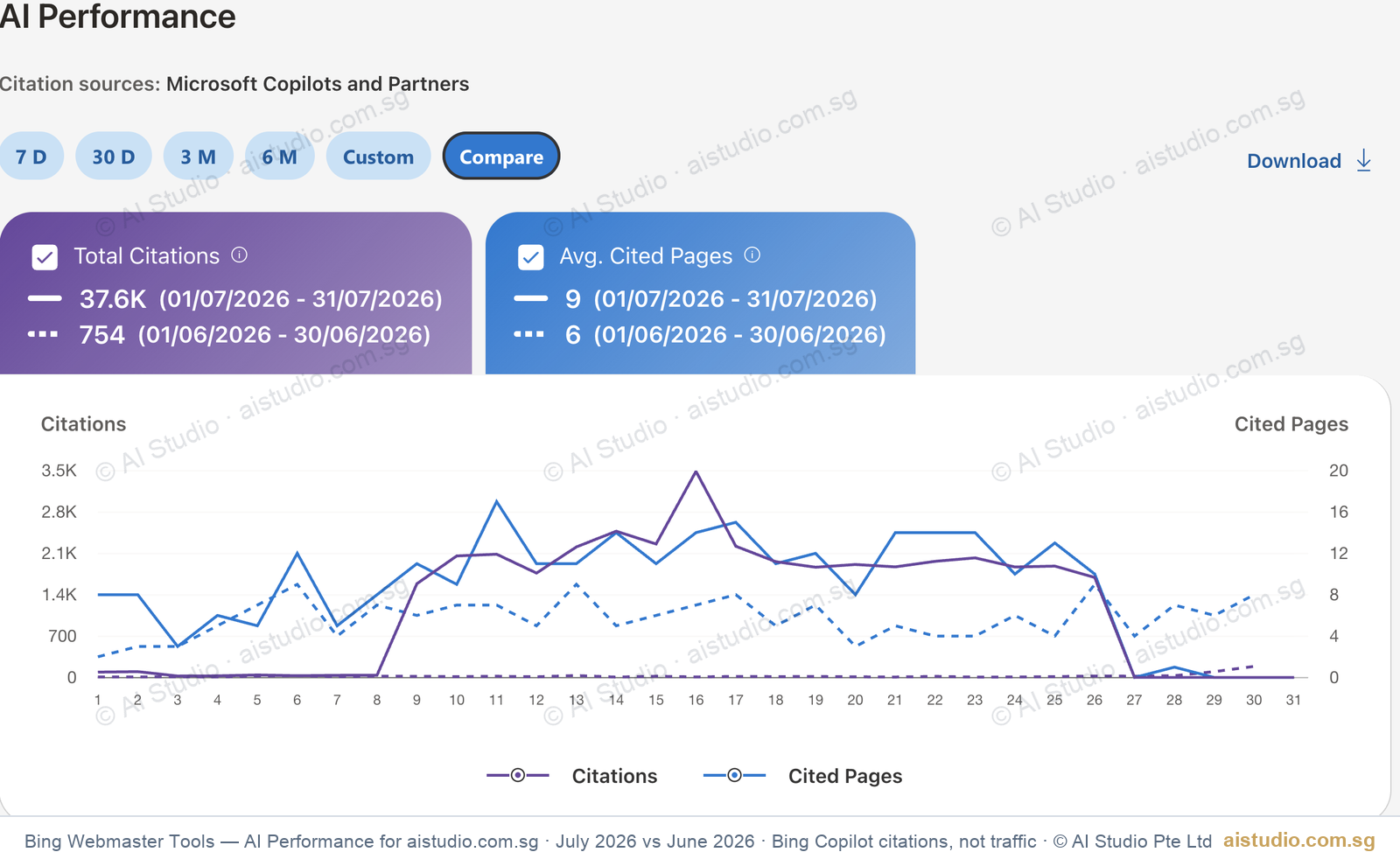
Quick answer: Our first-party Bing data shows AI citations for this site rose from 754 in June 2026 to 37.6K in July 2026, roughly 50 times, within a day of publishing eight answer-first guide pages. Those are Copilot citations, not traffic or leads. The lessons: publishing moves citations in steps, guides get cited while sales pages do not, and concentration in one query is the hidden risk.
On this page
- What we measured, and what a citation is not
- Finding 1: publishing produced a step change, not a curve
- Finding 2: two-thirds of visibility sat in one query
- Finding 3: guides earned citations, service pages did not
- Finding 4: the data itself can lie to you
- What we would do differently
- Frequently asked questions
What we measured, and what a citation is not
An AI citation is an instance where an assistant used one of your pages as a source when composing an answer — not a visit, a click or a lead. That distinction determines what every number below means, so it is worth settling before the findings.
The dataset is 92 consecutive days of Bing Webmaster Tools' AI Performance report for this site, from 30 April to 30 July 2026: 38,573 citations in total, across a maximum of 17 distinct cited pages in a single day, peaking at 3,487 citations on 16 July.
Three caveats up front, because they determine what the numbers mean. These are Bing Copilot citations, not traffic, leads or revenue — a citation means an assistant used a page as a source, nothing more. The queries recorded are grounding queries, the assistant's own reformulated retrieval searches, not what a human typed, so citation counts should never be read as a headcount. And this is one site in one market; treat it as a worked example rather than a benchmark.
Finding 1: publishing produced a step change, not a curve
We published eight pages on 8 July. The effect appeared the next day and it was not gradual.
| Window | Mean citations/day | Mean cited pages/day |
|---|---|---|
| 30 days before publishing (9 Jun – 8 Jul) | 33.9 | 6.2 |
| 18 days after publishing (9 Jul – 26 Jul) | 2,065.5 | 12.2 |
| Change | 61x | 2.0x |
96.4% of all citations in the 92-day series occurred after that single publishing date. Everything before it — three months of an already-established site — accounted for 1,393 citations, or 3.6% of the total.
The honest read is not "publishing content works", which is unsurprising. It is that the response was immediate and discontinuous. There was no ramp. Once the pages were indexed, they either matched the retrieval patterns assistants were already running or they did not. That argues for publishing in defined batches and measuring, rather than drip-feeding and hoping to observe a trend.
Finding 2: two-thirds of our visibility sat in one query
This is the finding we did not expect and the one that changed our plans. Of the citations attributable to the top grounding queries in the period:
- 68.1% came from a single grounding query
- 80.9% came from one query cluster on essentially one page
- The top eight queries accounted for 88.8% cumulatively
A headline citation count that large looks like success. It was also extremely fragile: one change in how Copilot reformulated that family of queries could have removed most of our AI visibility, and no amount of total-citation growth would have warned us.
This is why concentration deserves to be a tracked metric rather than an afterthought. We now read the concentration ratio — the share of citations from the largest cluster — alongside the total, and treat a falling ratio as a good outcome even when the headline number dips. Breadth is what makes a citation base durable.
Finding 3: guides earned citations, service pages did not
The distribution across page types was lopsided in a way that has held consistently. Comprehensive guides and comparison articles earned the overwhelming majority of citations. Commercial service pages — the pages describing what we sell — earned almost none, in some cases low single digits over a full quarter.
This makes sense once you consider what an assistant is doing. It is composing an explanation, and it needs sources that explain. A sales page asserts; a guide explains. The practical consequence is not to stop having service pages, but to accept that they will rarely be the cited asset and to link them clearly from the content that is. That is how we structure our own AI search optimisation work: the service page explains the offer, the guides earn the citations.
Finding 4: the data itself can lie to you
On 27 July our citations went from 1,692 the previous day to zero, across zero cited pages, and stayed near zero for several days. Read carelessly, that is a catastrophic ranking collapse.
It was not. The site had not changed — no deploy had happened for over two weeks. Crawlers were being served normally, the certificate was valid, every top-cited page returned a 200 with an indexable robots directive. And the shape of the drop was wrong: a genuine loss of even a major query cluster would have fallen back toward the baseline the rest of the site was earning, not to absolute zero across every page simultaneously.
The lesson is a diagnostic habit rather than a fact about Bing: before treating a metric collapse as a ranking event, check whether the shape of the drop is physically plausible. Real losses are partial and graded. A clean zero across every page at once is almost always a measurement failure, and responding to it by changing the site would have been the genuinely damaging move.
What we would do differently
- Track concentration from day one. We measured totals for months before noticing that most of the total rested on one query.
- Publish in batches and hold. The step-change pattern means a defined batch followed by a stable observation window produces a readable result; continuous small changes do not.
- Build breadth deliberately. Winning a query cluster decisively is worth less than being cited across several, because the second is survivable.
- Instrument before publishing. Baseline data is only valuable if it exists before the intervention, and it costs nothing to start collecting.
The page pattern that earned these citations, answer-first leads, question headings, schema and a visible FAQ, is written up step by step in our Copilot ranking playbook for Singapore.
The broader point: almost everything written about AI search optimisation is inference from the outside. First-party citation data is free to anyone with a website and a Bing Webmaster Tools account, and it disagrees with the received wisdom often enough to be worth reading yourself.
Frequently Asked Questions
How many AI citations did the study cover?
38,573 citations across 92 consecutive days, from 30 April to 30 July 2026, recorded in Bing Webmaster Tools' first-party AI Performance report for aistudio.com.sg. The peak was 3,487 citations in a single day on 16 July, across a maximum of 17 distinct cited pages in one day.
Does a higher citation count mean more traffic?
No, and conflating the two is the most common error in AI visibility reporting. A citation means an assistant used your page as a source when composing an answer — it does not imply a visit, a click or a lead. Assistant referral traffic is also systematically undercounted because some assistants pass no referrer, so neither number cleanly explains the other.
What is citation concentration and why does it matter?
Concentration is the share of your citations coming from your single largest query cluster. In our data, 68.1% of citations came from one grounding query and 80.9% from one cluster. That looked like success but was fragile: a single change in how an assistant reformulates that family of queries could have removed most of our visibility. Tracking concentration alongside totals turns an invisible risk into a managed one.
Why did citations drop to zero in late July 2026?
They did not, in any meaningful sense. The site was unchanged, crawlers were served normally, the certificate was valid and every top-cited page returned a 200 with an indexable robots directive. The drop's shape was also implausible — a genuine ranking loss falls back toward a baseline, not to absolute zero across every page at once. We treated it as a reporting gap rather than a ranking event, and deliberately made no changes in response.
Can other businesses replicate this measurement?
Yes, and at no cost. Bing Webmaster Tools' AI Performance report is free to any verified site owner and provides citations, cited pages, grounding queries and citation share. The main requirement is discipline rather than budget: start collecting before you make changes, publish in defined batches, and leave the site stable long enough to read the result.
Is Bing Copilot data relevant if my customers use Google and ChatGPT?
More than it first appears. Bing's index grounds Copilot directly, and ChatGPT's web search has drawn on Bing results, so pages Copilot cites tend to be retrievable by other assistants too. It does not measure Google AI Overviews, so treat it as one instrument rather than the whole dashboard: pair it with prompt testing on the assistants your buyers actually use, and read the direction of travel rather than any single day's figure.
How long before a new or small Singapore site sees citations?
We cannot promise a timeline, and we would be cautious of anyone who does. Our step change happened on an established site with existing authority and a clean technical base; a new domain has to earn crawl attention first. What we can say is that the format mattered more than volume: eight well-structured guides did more than months of ordinary publishing. Start with a small batch, instrument first, and give it a stable window before judging.
Related reading
- Enterprise AI Search Visibility: The Singapore Guide
- How to track AI citations: a 2026 guide
- The AEO experimentation roadmap
- AEO reporting: the metrics that matter
- The 10 best AEO tools in 2026
- AEO Agency Singapore
- AI search optimisation Singapore
- Copilot ranking playbook for Singapore
- the 90-day GEO roadmap we built from these findings
Want to be the answer, not just a search result?
AI Studio builds AI search visibility for Singapore brands — entity, schema, and the content that assistants actually cite. Start with a free AI Visibility Audit of your own site.