Proof · live AI citations
On this page
Where do enterprise buyers actually research now?
The procurement journey that used to start with ten blue links now starts with a question typed into ChatGPT, Copilot or Google’s AI Overviews — and the answer arrives pre-assembled, with a handful of cited sources. If your organisation is not among those citations, you are not losing a ranking position; you are absent from the conversation entirely.
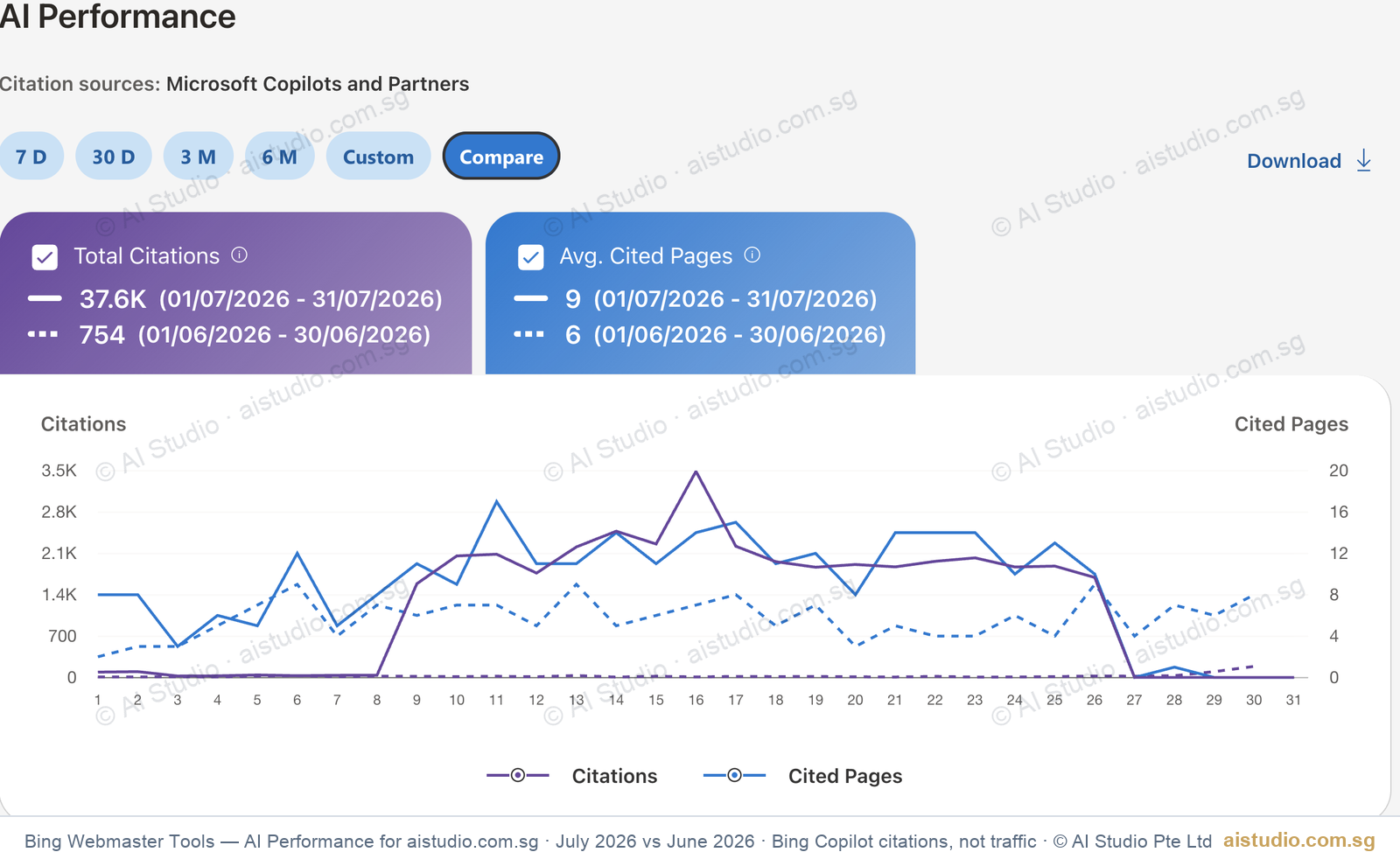
This is measurable, not theoretical. When we published eight answer-first pages on our own site in July 2026, Bing Copilot citations of our domain went from roughly 34 a day to a peak of 3,487 within eight days — 38,573 citations over the 92-day window, documented in our first-party data study. Citations, not traffic — but citations are precisely the currency AI engines deal in when your buyer asks “who should we shortlist?”
Why do enterprise sites underperform in AI search?
Enterprise web estates carry structural debt that small-business sites don’t, and AI engines punish exactly that debt:
- Brand-entity ambiguity. Multiple subsidiaries, legacy brand names and regional sites leave engines unsure which entity is which. An engine that cannot resolve your entity will not confidently cite it.
- Subdomain and microsite sprawl. Authority fragments across campaign microsites and country subdomains instead of compounding on one citable domain.
- PDF-locked knowledge. The most citable material — specifications, research, pricing structures — often sits inside PDFs and gated portals that answer engines cannot parse into answers.
- Schema debt. Templates built years ago carry thin or contradictory structured data, so engines read less about a 500-person company than about a five-person agency with a clean entity block.
- Committee-speed publishing. Answer engines reward pages that answer the question in the first paragraph. Enterprise sign-off chains tend to produce pages that spend four paragraphs on positioning before saying anything checkable.
What are AEO, GEO and SEO at enterprise scale?
These are three distinct disciplines, and an enterprise programme needs all three — run deliberately, not as one blurred “search” line item:
- SEO (Search Engine Optimization) keeps you ranked in classic results — still the widest funnel and the crawl foundation everything else depends on.
- AEO (Answer Engine Optimization) structures pages so answer engines — ChatGPT, Copilot, Perplexity — can quote you: answer-first leads, question-shaped headings, FAQ schema, consistent facts.
- GEO (Generative Engine Optimization) builds the entity and authority layer — organisation schema, consistent citations of your legal entity, third-party corroboration — so generative engines trust who you are and say so.
At enterprise scale the sequencing matters more than the acronyms: entity first (one unambiguous organisation), then structure (schema and answer-first pages on the money queries), then breadth (the long tail of buyer questions your teams already answer in decks and RFP responses). Our service pages cover each layer: AEO, GEO and SEO; the combined engagement is described under AI search optimization Singapore and the AI search programme page.
What does governance look like for AI search?
Enterprise teams rightly ask a question small businesses skip: who signs off on what the AI engines are told, and what are our obligations?
On obligations: Singapore’s PDPC has issued advisory guidance on the use of personal data in AI systems, including generative AI. As we read it, the guidance is advisory rather than legally binding, but it matters because of how it allocates responsibility — distinguishing model providers, system providers and system deployers. On that reading, a Singapore company calling ChatGPT, Claude or Gemini through an API is a deployer, with its own accountability for the personal data it sends. Check the current text on the PDPC site and take legal advice for your sector; we are not lawyers. Under the PDPA, the practical discipline is unchanged either way: treat any AI tool as any other third-party processor — know what you are sending, know where it goes, and record the decision. The wider adoption context — including current grant programmes — is covered in our AI for Business guide.
On brand safety: an AI-search programme is largely about publishing verifiable facts in machine-readable form — which is why it tends to reduce hallucination risk about your brand rather than add risk. The governance artefacts worth putting in writing are modest: a facts register (the claims engines may repeat), a named owner for schema changes, and a review cadence for what engines currently say about you.
How should you evaluate an AEO/GEO vendor?
Most vendor decks look identical. These criteria separate them quickly — use them as RFP questions:
| Criterion | What to ask | What a strong answer looks like |
|---|---|---|
| First-party proof | “Show us your own AI-search results, measured.” | Named metrics from their own domain (citations, cited pages, engine coverage), with dates and methodology — not screenshots of a client they can’t name. |
| Measurement method | “What exactly will you report monthly, from which sources?” | Bing Webmaster AI Performance, Search Console generative views, per-engine citation tracking — and honesty about what each source cannot see. |
| Guarantee shape | “What do you guarantee?” | A measurable citation lift against a kickoff baseline — never guaranteed rankings, traffic or lead counts, which no honest vendor controls. |
| Entity methodology | “How will you make our organisation unambiguous to engines?” | A concrete schema and entity plan naming your legal entity, properties and corroborating profiles — not “we optimise content”. |
| Editorial discipline | “Who verifies facts before they ship?” | A stated verification rule — every publishable claim checked against a source, unverifiable claims cut. |
| Coexistence | “How do you work alongside our incumbent SEO agency?” | A clean division: they keep classic rankings; the AEO/GEO layer adds entity, schema and answer-first structure — with shared reporting, not turf war. |
For the shortlist itself, our comparison of Singapore’s AI-SEO agencies applies these criteria to the current market.
What measurement can a committee trust?
Report three layers monthly, each from a named source: citations (Bing Webmaster’s AI Performance report — daily citation counts and cited pages), presence (which engines cite you for the priority buyer questions — tracked per engine), and direction (whether the base of cited queries is broadening — concentration falling is healthy even when a single query’s count dips). Google’s generative-AI views in Search Console report impressions only, and GA4’s AI-assistant channel misses engines that send no referrer — treat analytics numbers as a floor, never the total. The full tooling walkthrough is in our citation-tracking guide.
What does the pilot-to-scale path look like?
Start with one division or product line and a defined query portfolio. Establish a baseline, agree the technical and content work, then review the evidence before extending to more entities or markets. Enterprise programmes are quoted against that scope. Request your free AI Visibility Audit.
Frequently Asked Questions
Can AI engines say something wrong about our brand, and does this work make that worse?
Engines can already say wrong things about you today — that risk exists whether or not you act. An AI-search programme publishes verified, machine-readable facts, which gives engines a corroborated source to quote and typically reduces misstatement. A monthly review of what engines currently say about your brand should be part of the reporting.
How long before an enterprise sees movement?
Crawl-and-index effects — new pages cited, entity recognised — typically appear within 7–30 days of deployment. Meaningful citation share on competitive buyer questions is a quarter-scale outcome. Treat any vendor promising specific rankings on a date with suspicion; the honest guarantee shape is a measured citation lift against your kickoff baseline.
We already have an SEO agency. Does this conflict?
No — if the division of labour is written down. The incumbent keeps classic rankings and technical SEO; the AEO/GEO layer adds entity architecture, structured data and answer-first content for AI engines. The two share one reporting pack. What you should not do is run two vendors editing the same pages without a coordination rule.
Does this work for regulated industries?
Yes, with the governance artefacts made explicit: a facts register of approved claims, named sign-off for anything engines may quote, and personal data kept out of published material entirely — which also keeps you aligned with the PDPC’s advisory position on AI and personal data, under which (as we read it) your organisation carries deployer accountability for data it sends to model APIs. Confirm the current guidance with your compliance team.
What does enterprise AI search visibility cost in Singapore?
Start with one division or product line and a defined query portfolio. Establish a baseline, agree the technical and content work, then review the evidence before extending to more entities or markets. Enterprise programmes are quoted against that scope. Request your free AI Visibility Audit.
Can we run this in-house instead of appointing a vendor?
Yes, if you have three things: a content owner who can publish answer-first pages without a four-week sign-off chain, a developer who owns schema and the entity block, and someone to run monthly citation measurement. Most enterprises have the people but not the mandate. A common pattern is a one-quarter vendor pilot to build the facts register, schema and measurement setup, then a handover to the in-house team with a light advisory retainer.
Who owns the content and schema after an engagement?
You do. Everything ships on your domain, in your repositories — pages, schema, the facts register and the measurement setup. A vendor whose value depends on holding your assets hostage has answered the evaluation question for you.
Related reading
- What 38,000 AI citations taught us: the first-party data study
- How to track AI citations: a 2026 guide
- Best AI SEO agencies in Singapore (2026)
- AI for Business in Singapore: the complete guide
- AI search optimization Singapore
- AI search agency Singapore
- AI search optimization: the complete guide
- multilingual AI search in Singapore
- the baseline 25-check AI visibility audit checklist
- Enterprise AI creative production: the complete guide
- Enterprise AI creative agency service
What clients say
“AI Studio rebuilt our content so AI search engines actually cite us. We now surface in ChatGPT and Google AI Overviews for our category across Australia.”
— Steven Lee, General Manager, F&B chain, Australia
“Their AEO and GEO work put us in front of customers asking AI assistants for recommendations — visibility we could never have bought with ads alone.”
— Priya Nair, Marketing Director, Beauty brand, Singapore
Want to be the answer, not just a search result?
AI Studio builds AI search visibility for Singapore brands — entity, schema, and the content that assistants actually cite. Start with a free AI Visibility Audit of your own site.