A useful programme connects learning to the business. Before comparing course titles, decide what should be different after the session.
Step 1: How to choose AI training around a business problem
A team that needs a shared starting point may benefit from a workshop. A business that wants to organise company knowledge and complete a workflow needs preparation and guided build time.
Write a practical outcome, such as “Our sales champion can create a proposal draft from an approved brief and check it before sending.” This is easier to evaluate than “The team understands AI”.
Step 2: How to choose AI training with useful preparation
Company-specific work needs company-specific inputs. Ask which approved documents, examples, accounts and staff are required.
A provider should be able to explain how incomplete sources affect the session. If the process owner is absent or the necessary access is unavailable, a live build may not reach the expected result.
Step 3: Look for building experience you can inspect
Ask for a relevant example of the trainer's work and an explanation of what they contributed. A clear demonstration should show the input, process, output and review step.
A polished screenshot alone does not establish that a workflow works in a business. Equally, a fictional teaching example can be useful if it is labelled honestly and is not presented as a client result.
Step 4: Compare the deliverables
| Question | A useful answer should explain |
|---|---|
| What do we leave with? | Specific documents, workflow, instructions and ownership |
| What do staff practise? | Tasks close to their actual work |
| What counts as complete? | An agreed test or demonstration of independent use |
| What does the company retain? | Sources, templates and reusable instructions |
| Which tools are required? | Accounts, permissions and any subscriptions |
| What happens afterwards? | Scheduled support and its limits |
Be clear about whether a programme teaches a method, configures a tool, builds an integration or operates a workflow for you. These are different commitments.
Step 5: Ask how the programme handles mistakes
AI can produce unsupported facts or miss important context. Training should teach staff how to identify missing information, verify claims and retain approval over consequential outputs.
The appropriate review depends on the task. A creative idea and a commercial proposal need different checks. A useful provider should be able to explain those differences.
Step 6: Understand productivity evidence
Published studies can show what AI achieved in particular settings. They cannot establish the outcome of an unrelated training package.
Ask how your own task will be measured. Include preparation, checking, correction and maintenance, and compare work with a similar quality standard. A programme that discusses these trade-offs is giving you a clearer basis for a decision.
Step 7: Check scope and commercial terms
Ask for a written scope covering participants, preparation, tools, follow-up and work that requires a separate quote. Confirm what your team will build, who will maintain it and which subscriptions or integrations you will need.
Ask the provider to confirm the exact programme scope and commercial terms before booking.
Step 8: Choose someone who will own the work afterwards
An owner or internal champion helps the learning survive the session. They can maintain the company knowledge, collect staff feedback and decide which workflow to improve next.
For teams that already know what AI can do, this continuity is often the missing part: a shared foundation, a practical workflow and a person responsible for keeping both useful.
Step 9: Bring one task to the conversation
Tell the provider what your team repeats, which materials it uses and where the work gets stuck. Ask them to explain the proposed exercise and completion criteria using that task.
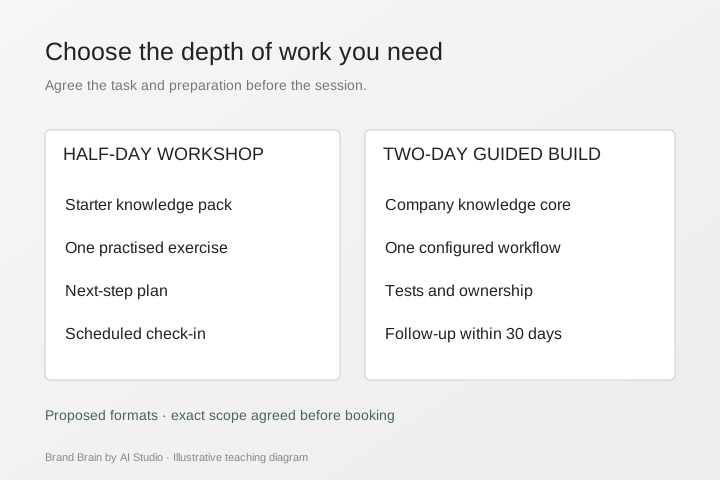
Our AI training begins with that conversation. A half-day Team AI Workshop creates a starter Brand Brain; the two-day guided programme develops the foundation and one selected workflow with your team.
Apply this with your team
Our AI training for businesses in Singapore explains AI Studio’s proposed workshop and guided-build formats.
Questions teams ask
Should we choose a public class or an in-house programme?
A public class may suit a shared foundation in tools. In-house work becomes useful when company sources, permissions and a specific workflow shape the training.
How can we assess a trainer’s building experience?
Ask to see relevant work and how they handled incomplete inputs, review, ownership and maintenance. Check what they actually built.
What can a half-day workshop realistically achieve?
With prepared material, it can establish a starter knowledge pack and practise one task. A complete integrated business system requires more scope.
Does a higher fee prove a better outcome?
No. Compare the work included, preparation, completion criteria and support boundaries, not just session duration or price.
What should happen after the course?
Someone in the business should own the sources and workflow. Agree the review period, support arrangement and how actual use will be checked.