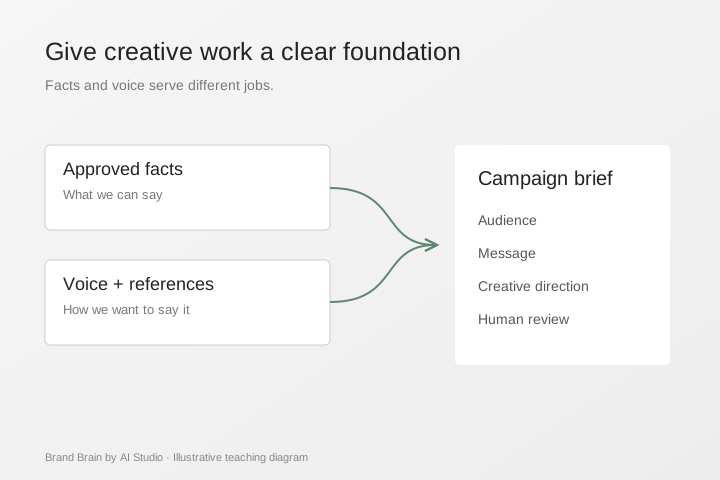
The goal is consistency with room for judgement. Start with a small set of approved examples and explain why they work.
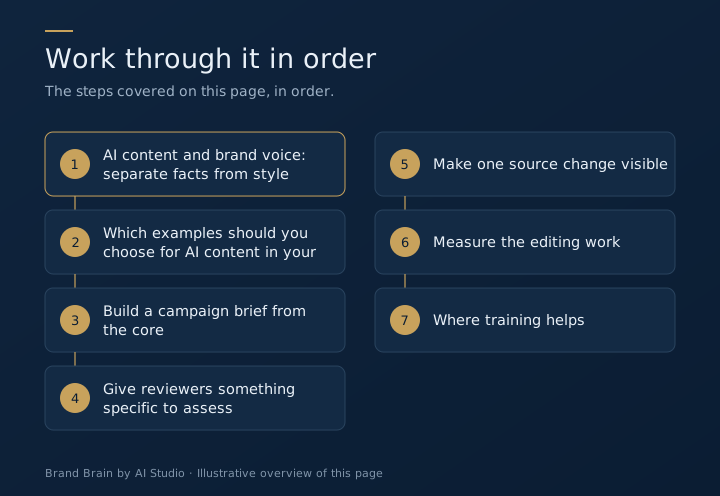
Step 1: AI content and brand voice: separate facts from style
Facts include product details, service scope, audience needs and evidence for claims. Style includes tone, sentence length, vocabulary and the way you explain an idea.
An output can sound right while getting a fact wrong. Keep the two review steps separate. A lively tone does not give AI permission to invent a result or strengthen an unsupported claim.
Step 2: Which examples should you choose for AI content in your brand voice?
“Professional, friendly and innovative” leaves a lot open to interpretation. Give a concrete preference instead.
For example: “Use short sentences. Explain the practical outcome before the technology. Avoid claims such as effortless or guaranteed. Describe the next step clearly.”
Add a few approved pieces and annotate them: this introduction starts with a real customer question; this paragraph uses a useful example; this CTA tells the reader what will happen.
Step 3: Build a campaign brief from the core
A reusable brief should identify the audience, problem, offer, proof, channel, required action and constraints. Pull approved company material from the Brand Brain, then add the campaign-specific information.
For an illustrative launch campaign, the core might contain product facts and voice rules. The brief adds the launch objective and audience. The workflow creates a message direction, content outline and visual brief for review.
A creative board can bring together approved references and a proposed direction. It is not evidence that an AI-generated image accurately depicts a real product. Product identity and rights still need checking.
Step 4: Give reviewers something specific to assess
| Check | Question |
|---|---|
| Audience | Does the opening address the reader's actual problem? |
| Facts | Can each meaningful claim be traced to an approved source? |
| Voice | Does this resemble the selected examples for a clear reason? |
| Channel | Is the format usable where the content will appear? |
| Action | Does the reader know the next step? |
| Visuals | Are products, people, rights and labels accurate? |
Keep feedback reusable. “Too generic” is hard to apply. “Replace the broad claim with the exact service outcome from the approved brief” teaches a more useful rule.
Step 5: Make one source change visible
Suppose an approved service description changes from a two-week turnaround to a schedule agreed after briefing. The core's owner updates the source, and the team checks the campaign drafts that depend on it.
That is a maintenance process, not a magical live connection. Each tool and publishing destination needs a defined update path.
Step 6: Measure the editing work
Compare time spent preparing the brief, generating drafts, checking facts and revising. Record which changes repeat. If the same correction appears every week, improve the source or instruction instead of fixing every output manually.
Do not measure success by the number of drafts alone. More drafts can create more review work.
Step 7: Where training helps
The Team AI Workshop helps staff build a starter knowledge pack and practise a useful output. The guided Build Programme goes further: your team organises its company sources, builds one selected workflow and learns to maintain it.
Bring approved company information and a few pieces you consider strong. We can then work on the specific gap between “AI can write” and “our team can produce work that fits our business”.
Apply this with your team
Our Brand Brain training for company knowledge shows how to connect voice, facts and examples before producing more content.
Questions teams ask
Is a tone-of-voice adjective enough?
An adjective is open to interpretation. Pair it with approved examples, specific language choices and examples of wording to avoid.
Can we use competitors as examples?
Use relevant references to discuss a direction. Do not treat another company’s claims, content or protected assets as your own.
How does this help creative boards?
The knowledge pack can supply audience, offer, message and visual rules for a creative brief. The team still selects and approves the direction.
What changes for different channels?
Keep the approved facts consistent while adapting length, structure, visuals and next action to the channel and audience.
How do we measure improvement?
Compare the time and corrections needed to reach an approved output. More drafts alone do not prove better content.