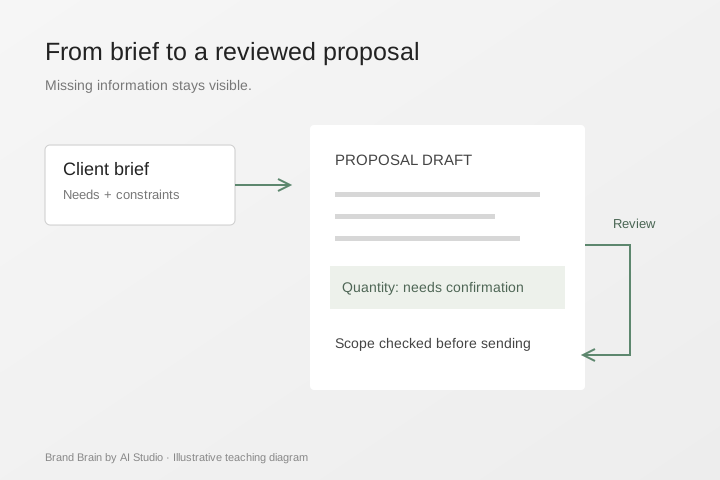
If you simply ask for “a winning proposal”, the result may sound polished while getting the scope wrong. The more useful question is: what should the draft know, what must it ask, and what needs human approval?
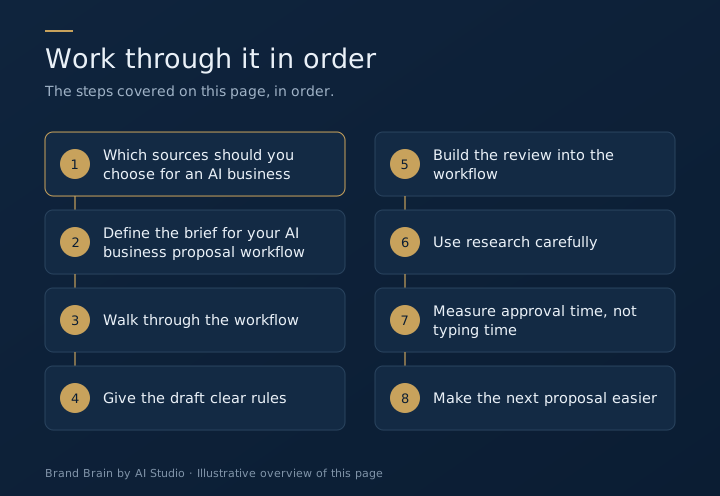
Step 1: Which sources should you choose for an AI business proposal workflow?
Create a reusable source pack with your services, scope options, delivery process, relevant examples, exclusions and commercial rules. Assign an owner to material that can change.
Keep each prospect's brief separate from that shared pack. Their objectives, quantities, dates and constraints belong to the opportunity. Do not let one client's requirement become a default for everyone.
Step 2: Define the brief for your AI business proposal workflow
A simple intake can capture the following:
- What the client wants to achieve and why.
- Required deliverables and quantities.
- Audience, market and intended use.
- Timing, dependencies and decision makers.
- Known budget, if actually supplied.
- Open questions and information awaiting confirmation.
A blank field should remain visible. The workflow should flag a missing budget rather than invent one.
Step 3: Walk through the workflow
For this illustrative example, a small design company receives a request for a product-launch campaign. The brief names the audience and launch date but leaves asset quantities open.
First, the workflow extracts the known requirements. Next, it identifies relevant approved services and examples. It drafts a proposed scope with the quantity gap clearly marked. It then produces questions for the client before preparing a sendable version.
The output is a useful starting point for a conversation. It should not become a contract merely because it looks complete.
Step 4: Give the draft clear rules
A reusable instruction can be short:
Use the supplied client brief and approved company sources. Distinguish requirements, recommendations and assumptions. Flag missing information. Do not invent prices, quantities, case results or contractual terms. List the decisions needed before this proposal can be sent.
Treat this as an example to adapt, not a universal prompt that replaces a proper brief.
Step 5: Build the review into the workflow
| Review area | What to check |
|---|---|
| Client truth | Name, objectives, audience and requirements match the actual brief |
| Scope | Every output has a clear quantity or an explicit unresolved question |
| Commercials | Fees, tax treatment and payment terms come from approved sources |
| Delivery | Timing, dependencies, responsibilities and exclusions are coherent |
| Evidence | Relevant examples are accurate and permitted for use |
| Final document | The exported file is readable, complete and the correct version |
Keep a responsible approver before sending. A workflow that can draft commercial language should not automatically gain authority to commit the business.
Step 6: Use research carefully
In a 2023 experiment involving 453 professionals, ChatGPT reduced time spent on selected writing tasks by 40% on average. The tasks were not full client proposals and did not require the precise company context of a commercial engagement. That supports testing drafting assistance; it does not predict your proposal turnaround. Read the MIT account of the study.
Step 7: Measure approval time, not typing time
Record the time to gather information, draft, review, revise and prepare the final file. Compare proposals of similar complexity. Also record missing scope, factual corrections and the number of review rounds.
If drafting becomes quicker but commercial review takes longer, improve the sources or narrow the task. The useful result is a dependable process, not simply more text.
Step 8: Make the next proposal easier
After approval, save the reusable lesson: a clearer service description, a better question or a corrected scope rule. Keep client-specific material restricted and label examples accurately.
Brand Brain training helps your team build this source structure, configure a selected proposal workflow and learn the review process. Live CRM connections, automated sending and additional integrations require their own scope.
Apply this with your team
Our Brand Brain Build Programme can use a proposal as the selected workflow when sources and scope are ready.
Questions teams ask
Can AI set our proposal price?
Use approved commercial sources. If a fee is missing or needs judgment, the workflow should flag it for the responsible person.
What if the client brief is incomplete?
Produce a visible list of open questions. Do not fill gaps with invented scope, deadlines or quantities.
Can we reuse a previous proposal?
Use permitted examples for structure and relevant service wording. Keep client-specific terms separate from your common source pack.
Does this require a CRM integration?
A first workflow can use a prepared brief and approved documents. A live CRM connection requires its own access, mapping and tests.
What should we measure?
Track preparation, drafting, review, corrections and final-file work for proposals of similar complexity, alongside quality.