Corporate AI training in Singapore. Built around your business.
At a glanceCorporate AI training in Singapore helps teams use their own company knowledge to improve a real business workflow. AI Studio teaches you to build a Brand Brain, choose a department module and test the output. Start with a half-day workshop or a two-day guided build, scoped around your team’s task.
The sales report says S$48,000. The bank says S$20,000.
See what has been won, billed and collected before deciding what needs attention.
S$48kwon contract value
S$30kinvoiced
S$20kcash received
What connects: Won contracts + delivery milestones + invoice and receipt records. Brand Brain supplies the billing rules and metric definitions.
See the sample data and calculation
Fictional project cohort: S$48,000 of won contract value; S$30,000 invoiced; S$20,000 of those invoices paid. S$18,000 remains unbilled and S$10,000 invoiced but unpaid. No conclusion about recognised revenue, overdue debt or profit follows without dates, terms and costs.
Four quotes need a scope decision before they go out.
Surface exclusions, missing inputs and unapproved extras while the decision is still open.
12quotes prepared
4need scope review
2missing approval
What connects: Client brief + current offer + scope changes and approvals. Brand Brain supplies inclusions, exclusions and escalation rules.
See the sample data and calculation
Fictional review queue: 12 proposals; four need scope review. Two of those four also lack commercial approval, so they are not six separate problem quotes. No contract value is treated as profit.
A lead costs S$25. A qualified opportunity costs S$100.
Judge the campaign against the customers you want, then reuse the messages that brought them.
S$3kcampaign spend
120enquiries
30qualified
What connects: Campaign spend + creative variants + matched lead outcomes. Brand Brain supplies the ideal customer, approved claims and brand voice.
See the sample data and calculation
Fictional single-campaign cohort: S$3,000 ÷ 120 enquiries = S$25 per enquiry; S$3,000 ÷ 30 qualified enquiries = S$100 per qualified enquiry. These figures exclude staff and delivery costs and do not establish profit or return on investment.
Separate the missing purchase order from the unfinished handover so the right person can act.
S$18kunbilled work
S$10kawaiting PO
S$8kawaiting sign-off
What connects: Agreement + delivery evidence + billing records. Brand Brain supplies required documents and who can approve an invoice.
See the sample data and calculation
Fictional billing queue: S$10,000 awaiting a required PO + S$8,000 awaiting completion sign-off = S$18,000 unbilled. This is separate from the S$10,000 invoiced but unpaid in the revenue example. Unbilled does not mean overdue or immediately collectible.
What would a shorter review cycle give your team back?
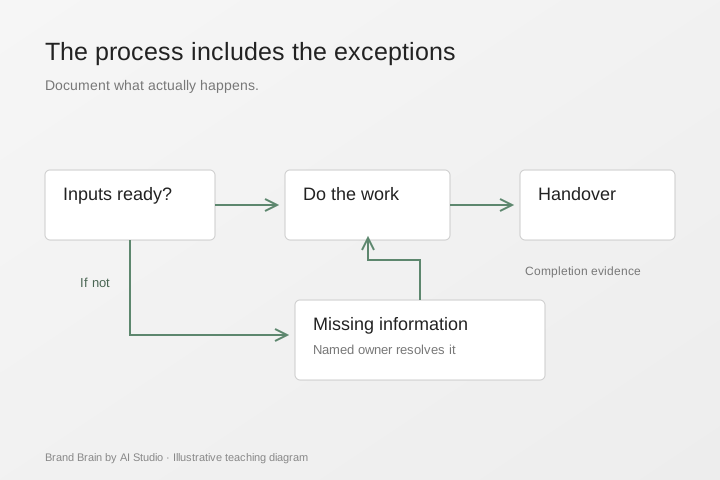
Build a repeatable handover with the inputs, checks and exception route already defined.
20task checks each week
15 → 6minutes per review
3 hoursweekly illustration
What connects: Task log + existing SOP + exception notes. Brand Brain supplies the checklist, responsible person and completion standard.
See the sample data and calculation
Time illustration, not measured savings: 20 task checks × (15 − 6) minutes = 180 minutes, or 3 hours per week. Both timings include human checking. Setup, training, maintenance and exceptions are excluded. Measure your own baseline and test the workflow before assuming any saving.
Four open cases are waiting on someone outside support.
Carry the customer history into the handover, so the next reply moves the case forward.
18open cases
4waiting on an owner
3repeat contacts
What connects: Customer history + previous replies + case status. Brand Brain supplies service boundaries and escalation rules.
See the sample data and calculation
Fictional support queue: 18 open cases; four await a decision owner. Three of the 18 have repeat contacts and may overlap with those four. Response count is not a resolution rate or customer satisfaction score.
One launch. Two versions still carry an old claim.
Trace the affected versions and put the approved message in front of every reviewer.
6draft assets
2outdated claims
1approved fact sheet
What connects: Fact sheet + press draft + sales and social versions. Brand Brain supplies approved claims, source dates and spokesperson rules.
See the sample data and calculation
Fictional launch review: six draft assets checked against one approved fact sheet; two contain an outdated claim. Drafts stay with their owners for correction and approval before release.
Three starter tasks are still waiting for the boss.
Give the new hire the current answer, the responsible person and a safe next step.
8starter tasks
3need a decision
2missing source owners
What connects: Role checklist + current process + access requirements. Brand Brain supplies task ownership and approval boundaries.
See the sample data and calculation
Fictional onboarding checklist: eight tasks; three require a decision and two lack a named source owner. The groups can overlap. This is a workflow example, not a measured reduction in onboarding time.
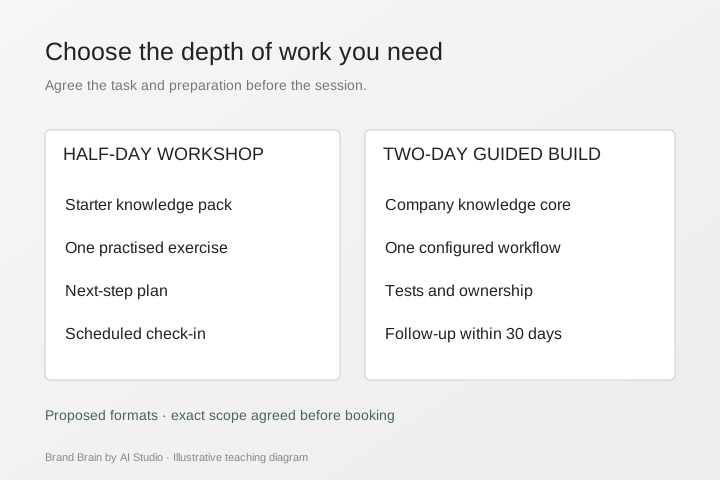
Prepared company material; one or two scoped exercises
Starter knowledge pack, reusable instructions and next steps
Two-day guided build
Approved sources and access for one workflow
Configured steps, test examples and a named reviewer
The opportunity isn’t always in the next lead.
Sometimes it’s in the quote nobody followed up. The client who mentioned an expansion. The work that never reached Accounts.
Your Brand Brain
Fictional sample data · interactive demonstration
You
Show me the opportunities we already have.
Company recordsMatch the contextFind the next step
▤Sales pipeline2 sent quotes✓
Account
Quote
Next contact
HR-014
S$8,000
Not recorded
JF-023
S$6,000
Not recorded
≋Customer conversationsMatched by account ID✓
HR-014 · C-021 · Harbor Retail
“Can you confirm delivery before we proceed?”
▦Account historyCustomer history✓
AF-009 · Atlas Fitness
Existing customer. Service note: “We are opening two more rooms. Can you help?”
✧
Needs a next stepS$14,0002 open quotes · not won revenue
Buying question without a recorded reply
Harbor asked about delivery. The quote is still open.
An S$8,000 quote and a buying question share account ID . Jo can check the delivery answer and record the next contact.
Changes this sample only. No message is sent.
Another signal
Atlas mentioned two new rooms. Its customer history connects that request to an existing relationship. Confirm the scope before pricing.
What connects these records?
The company rule
Every open quote needs an owner and a next contact. Expansion signals need a scope conversation before pricing.
What the figures mean
Open quote value is not won revenue. The expansion is unpriced. A missing activity record does not prove nobody replied.
▤Campaign resultsCAM-07✓
S$2,400 spend80 enquiries
≋Qualification listSame campaign cohort✓
20 qualified25% of enquiries
▦Sales activity20 matched lead records✓
0102030405060708091011121314151617181920
Call booked No follow-up recorded
✧
Paid-for enquiries. An unfinished handover.13 / 20qualified leads with no recorded follow-up
7 calls booked13 need a next step
The gap is after qualification.
You paid S$120 per qualified lead. Before increasing the budget, review the missing activity and give each next contact an owner.
Local sample update. No contact or sale is implied.
What connects these records?
The company rule
A qualified lead matches the agreed customer profile. Every qualified lead needs an owner and a next step.
What the figures mean
One fictional campaign cohort. No activity recorded does not prove no contact occurred. A scheduled follow-up is not a booked call or a sale.
▤Won projects4 won projects✓
Project
Contract value
P-041 · Harbor Retail
S$20,000
P-042 · Juniper Foods
S$10,000
P-043 · Atlas Fitness
S$10,000
P-044 · Cedar Office
S$8,000
≋Billing requirementsTwo incomplete handovers✓
P-043 · AtlasMissing PO
P-044 · CedarAwaiting sign-off
▦Invoices & receiptsMatched to project IDs✓
S$30,000 invoicedS$20,000 received
✧
Won work, not yet invoicedS$18,000S$48,000 won − S$30,000 invoiced
S$20kreceivedS$10kinvoiced, unpaidS$18kunbilled
Two blockers. Two different owners.
Atlas · missing purchase orderS$10,000
Cedar · completion sign-offS$8,000
The account owner checks the PO. The project owner confirms completion. Accounts verifies the billing conditions.
A received PO does not issue an invoice or collect cash.
What connects these records?
The company rule
Confirm the agreed billing requirements and project approval before issuing an invoice.
What the figures mean
Won contract value, invoices and receipts are different measures. Unbilled and unpaid amounts are not profit or automatically overdue.
▤Campaign performanceSame period · different audiences✓
Creative
Enquiries
Qualified
Product in use
80
20
Trend-led
60
6
≋Buyer feedback3 qualified buyers✓
Three buyers asked to see the product working in a small office.
Buyer notes · FB-04, FB-05, FB-06
▦Brand rulesApproved company context✓
PracticalCalmSpecific
Approved product facts. No inflated claims.
Brand rules not supplied. Tone and claims still need review.
✧
The signal in your own campaign data
25%Product in use · 20 / 80 qualified
10%Trend-led · 6 / 60 qualified
Proposed direction
Show it working. In a space like theirs.
A small-office demonstration, using approved product facts and the company’s practical voice.
SettingA real small officeProofProduct in useVoiceCalm and specific
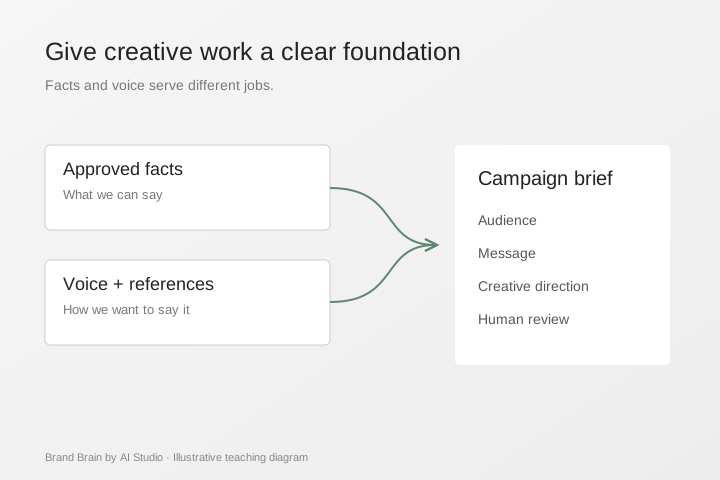
The campaign suggests what to test. Buyer feedback shapes the setting. Brand rules shape the message.
What connects these records?
The company rule
Practical, calm, specific. Use approved product facts. No exaggerated promises.
What the figures mean
Same reporting window, different audiences. These ratios do not prove the creative caused the difference or predict the next campaign.
Explore the sample records and their connections.
We teach your team to build this foundation. Your company knowledge, your working rules and a tested workflow—with the agency that builds AI for clients.
Prepared examples with local sample calculations. No live AI or company accounts are connected. Real workflows require data access, configuration and human review.
Built for owner-led SMEsTypically 5–30 staffOne company foundationChoose the departments that matterLearn it. Build it.Focused modules or a guided build
Where the business gets stuck
Your team is busy. What is it costing you?
Choose a situation you recognise. Follow what goes wrong, why it matters and the workflow your people can learn to build.
Marketing + sales + accounts
Marketing says the leads are good. Sales says they are rubbish. You are still paying.
Your ad report counts enquiries. Sales keeps the conversations. Accounts knows who paid. At the next budget meeting, everyone has a different version of what worked.
What it costs the business
You could keep paying for enquiries that never fit your offer, or cut a campaign that brings fewer but more valuable customers.
What a better working day looks like
Know what deserves the next dollar.
Bring the customer journey into the budget discussion. See where a defined group of enquiries progressed, where they stopped and what the records cannot yet tell you.
The customer asked for a quote. Why are we still chasing information internally?
The salesperson needs the current price. Delivery needs to check capacity. The useful case study is on somebody else’s laptop. The customer is ready to decide, but your team is not ready to answer.
What it costs the business
The follow-up becomes “just checking in” while the buyer’s real concern remains unanswered. A promising conversation can go quiet before anyone understands why.
What a better working day looks like
Follow up with the answer the buyer needs.
Give the salesperson the open question, the relevant proof and a clear next step. Keep the decision moving without asking the owner to reconstruct every conversation.
You won the job. Why did you barely make anything?
A discount was agreed during sales. An extra request arrived in a message. Delivery picked it up, but the quote and accounts record still describe the original job.
What it costs the business
The team works harder while the business absorbs the extra cost. By the time the difference is noticed, the work may already be finished.
What a better working day looks like
See the scope change while you can still act.
Make the difference between what was sold and what is now requested visible. Give the right person a chance to clarify, approve or requote before more work begins.
The work is finished. Why can’t accounts send the invoice?
Accounts is waiting for completion evidence. The purchase order is with sales. The owner assumes payment is on its way, but the invoice has not even gone out.
What it costs the business
Your team has done the work and incurred the cost. A missing handover delays the billing process before the customer’s payment terms even start.
What a better working day looks like
Know exactly what is holding up billing.
Separate work ready to bill from missing documents, overdue invoices and disputed amounts. Give every blocker a person and a next action.
You have past campaign results, customer questions and sales feedback. Yet the next brief starts with “what is trending?” Then you rewrite the output because it sounds nothing like your company.
What it costs the business
Budget goes into new ideas without carrying forward what the business already learned. Reach gets mistaken for buying interest, and the owner becomes the final editor again.
What a better working day looks like
Give the next idea a reason to work.
Bring relevant campaign evidence, buyer concerns and approved brand messaging into the brief. Explain what to reuse, what to change and what the next campaign should test.
Can you take a few days off without routine decisions coming back to you?
The answer exists in a message, an old document or your head. Staff ask you which version is right, what was promised and whether the same exception still applies.
What it costs the business
Routine work waits for your reply. New hires learn by interrupting the busiest person, and customers hear different answers from different people.
What a better working day looks like
Give the team answers they can act on.
Make current guidance, relevant history and decision owners easy to find. Keep unusual cases visible so staff know when to escalate instead of guessing.
Teaching scenarios, not client results. We configure and test a selected workflow with your approved records and people. Calculations use defined rules; actions and commercial decisions remain subject to review.
One customer. Six teams. A connected story.
A lead is not an invoice. An invoice is not cash. But the records should be able to tell the same story.
Follow a fictional project from its first enquiry to the owner's review. See what each team contributes, what the company brain adds and what happens next.
Follow the handover, one team at a time.
Marketing sees its part
The enquiry has a source.
Campaign record + approved offer
Brand BrainShared facts, rules and responsibilities
Campaign CAM-24 → enquiry C-104
What moves through the business
What is captured
The campaign ID, customer question and the reason the offer is relevant.
What carries forward
Sales receives the original need and source, rather than a name with no context.
What comes back
Qualification and later outcomes help marketing judge the quality of the response.
Interactive teaching example, not a live integration. All records are fictional; amounts are in SGD, with tax omitted for simplicity. Real connections require approved sources, matching IDs, access, configuration and testing. Your accounting system remains the source of record for its figures.
A company brain gives the records meaning.
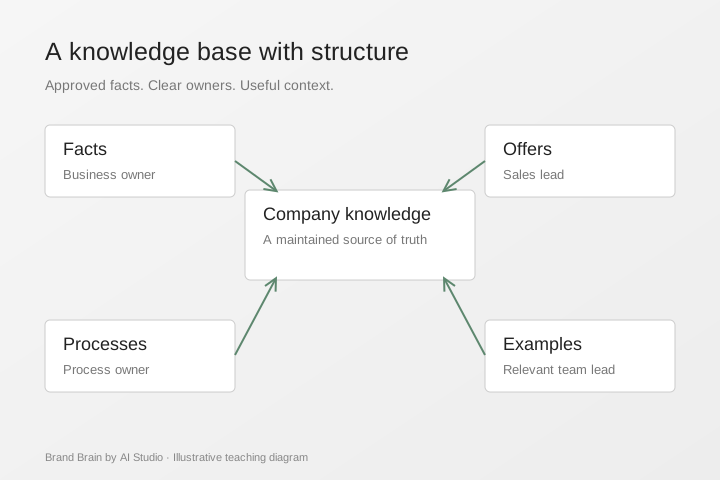
Your records say what happened. Your Brand Brain holds what your company offers, promises and allows. The configured workflow connects those two, then prepares an action for the person responsible. Training covers all three, starting with one selected process.
Choose the part of the business
Choose your AI training module
Choose the business area your team wants to improve. We teach you how to use your company knowledge, then help you build and test a workflow for that area.
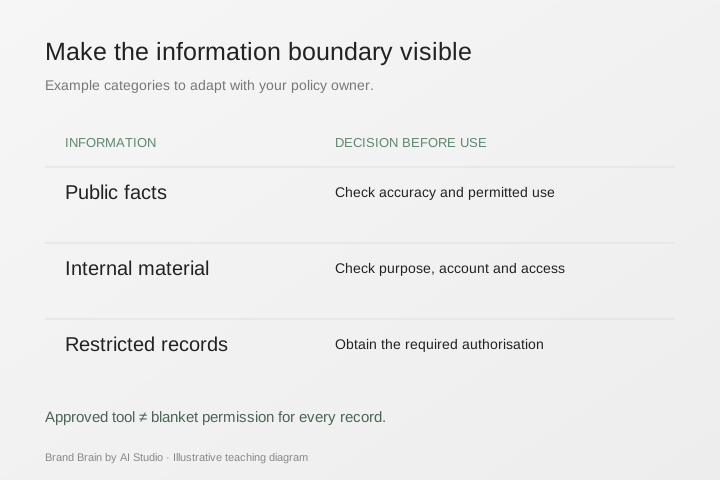
One shared foundation does not mean everyone sees everything. Sales, finance and people records keep the permissions they need.
Who should join
Your team knows AI. Now make it useful to the business.
Built for owner-led Singapore SMEs, typically 5–30 staff. The owner brings the commercial priorities. A champion helps the team adopt the workflow. Staff bring the real customer questions and work that keeps getting stuck.
For larger teams, we scope the department, participants and delivery format together.
What does the company actually get?
Training is the method. A capability your team can use in the business is the point. The depth depends on the format you choose.
Your company knowledge kit
Approved offers, customer context, voice rules and relevant examples, with someone responsible for updates.
A focused department workflow
Choose revenue review, campaign learning, proposals, finance exceptions or the process that matters first.
A team that knows how to use it
Practise the task with your own material. Learn what to check, when to ask and when a person must decide.
A way to measure the change
Agree a baseline and useful measures: lead quality, follow-up completion, review work or owner involvement.
A programme that fits the team
Corporate AI training formats for Singapore teams
Everyone starts with the same foundation. Then we tailor the practical work around your departments and priorities. More modules do not automatically mean more systems built.
Shared foundation
Build your Brand Brain
Approved facts, offers, voice, processes, metric definitions and source owners. Agree access and review rules before using department data.
Half-day workshop
One or two focused modules
Prepared sources, demonstrations and guided exercises. Two related topics can fit when their scope is narrow; the agenda is agreed first. This is a starter capability, not two completed integrations.
Additional modules, complex data preparation, live connections and ongoing operation are scoped separately. We confirm the people, sources, preparation and completion test before booking.
Learn it. Build it with us.
Choose a business problem, then the depth of help your team needs. Both formats use your company material. The two-day programme goes further into setup and testing.
Two guided days · up to 6 participants
Brand Brain Build Programme
For an owner and team ready to build a repeatable workflow across the departments that matter around their own business.
Your company knowledge foundation.
One workflow built and tested with your team.
Reusable instructions, review steps and ownership.
We agree the selected task, tools, preparation and scope before booking. Tool subscriptions and additional integrations are discussed separately.
Taught by the people doing the work
What makes our corporate AI training different?
AI Studio builds AI video, AI search visibility and automation for business clients. We work with briefs, brand consistency, missing inputs, review rounds and handovers as part of delivering that work.
That is how we approach training too: choose a useful business problem, build around your real information, test the process and teach your team to run it.
Your offers, voice, processes and examples become a reusable company foundation. Use it with a suitable frontier model, agent or local setup.
Your Brand BrainFacts · voice · processes · examples
ChatGPTUse an approved context pack in your chosen workspace.
Your company’s workBriefs · replies · proposals · handovers
We prepare reusable context and task instructions, then configure and test the selected workflow in the agreed ChatGPT setup.
Options to assess during scoping. Access, connectors, model capability and setup vary. Local models need suitable hardware or hosting. Brand Brain is training and implementation by AI Studio; platform names and logos identify third-party options and do not imply endorsement.
One core. Many useful next steps.
Company facts, examples and rules become context you can reuse. Pick a department to see how the same foundation supports a different job.
Start with the right sources.
Client briefConfirmed requirements
Scope and commercial rulesApproved options and boundaries
Relevant proposal exampleStructure, not copied client terms
Shared launch window: NovemberA company fact used across these examples
→
Illustrative company workflowDraft for review
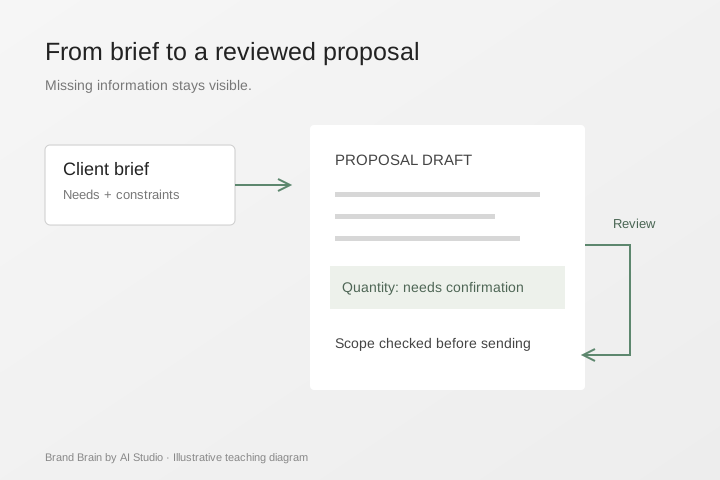
An outline that knows what is still missing
Proposal outline · Meridian
Target planning window: November.
Scope: review working needs, develop a zoning direction and prepare a handover.
Waiting on: floor plan and site constraints.
Commercial terms: owner to confirm.
Owner verifies scope, quantities, fees and terms. Nothing sends automatically.
Change the example source, then explore another department. The shared context carries through.
These are interactive teaching examples. A real setup needs approved sources, permissions and testing in your chosen tools.
Your company owns the knowledge.Your team learns the workflow.Your people approve the important decisions.
The pressure is real. Choose a problem you can act on.
Singapore research supports focusing on costs, customers and cash flow. The figures describe business challenges, not results from our training.
66%
cited increasing costs / reduced profitability as a business challenge.
56%
cited sales growth / reduced customer spending.
51%
cited financial challenges, including cash flow and funding.
QBE Singapore SME Survey 2025: 600 decision-makers; fieldwork December 2024 to January 2025; published 17 February 2025. The survey is not limited to teams of 5–30.
Why the connection between teams matters
In HubSpot’s published PSB Academy case, marketing could not see which campaigns generated suitable leads. Connecting campaign sources with sales lifecycle updates gave the teams a shared view of the customer journey.
External enterprise example, not an AI Studio client or a result promised by this programme.
Start with a build your team can actually run
SBF’s digitalisation findings identify implementation cost and a lack of knowledge among the barriers to AI adoption. Our starting point is one agreed process, prepared sources, a named owner and clear checks.
The sessions use prepared company material and a selected business task. Participants build, review and repeat the work with clear ownership.
Which training format should we choose?
Use the half-day workshop for a shared method and starter knowledge pack. Choose the two-day guided build for a fuller foundation and one tested workflow.
Can larger teams enquire?
Yes. We discuss departmental needs, participants and delivery requirements before proposing a separate corporate scope.
Does AI Studio teach businesses that already use AI?
Yes. The focus is on the gap between separate experiments and a connected way of working across company sources and responsibilities.
What information helps you scope the training?
Tell us the recurring task, team size, existing tools and the result you want. We then discuss source preparation, permissions and completion criteria.
Choosing training or researching workforce support?
This page covers AI Studio’s corporate training and guided workflow builds. For a separate overview of workforce-development support, read our Singapore AI training support guide. Funding rules are separate from our training offer; no subsidy is promised for these programmes.
Our agency work, featured in the media
Carol Tan and AI Studio’s team bring the agency’s AI creative, search and automation work into the training approach. The exercises on this page are teaching examples; they are not reported client results.
Tell us which business area you want to improve. We’ll help you choose the training module, prepare the company information and agree the workflow your team will learn to build.