
In this guide
- State which world details are fictional and which need historical research.
- Give Shen Yue and Lu Wen unequal knowledge, distinct risks and visible arcs.
- Track costume, decree, seal, ledger, camera position and state across each shot.
Set the research boundary before designing the world
The Jade Ledger is a fictional palace drama, not a reconstruction of a named dynasty. If the project draws on a real period, list the visible details that need research, titles, objects, writing, dress, architecture and social rules, and keep invented rules clearly separate. This lets a Singapore producer or commissioning team decide what requires a subject reviewer before scripts and art lock.
Set a research question for each visible claim: “Is this title, seal form or archive procedure tied to a named period?” Keep the answer and source beside the storyboard panel. Until checked, label the design choice as fictional and do not present it as evidence of historical practice. In The Jade Ledger, the forged decree and archive access rules belong to the invented world; if a later brief selects a real dynasty, identify which costume, document and institutional details need qualified review before approval.
Write the world’s dramatic rules in plain language: who can enter the archive, how a decree is recorded, who may challenge an order, and what consequence follows if evidence is altered. The rules should constrain the characters. A viewer can then understand why an archivist cannot simply carry the document away and why the inspector’s authority matters.
For a serial format rather than one complete film, use the episode-turn method for a continuing story question.
For an invented world, the fantasy world-building guidance helps separate consistent visual rules from historical claims.
Give the archivist and inspector unequal knowledge
Shen Yue, the archivist, knows the archive’s records, seals and handling history. She wants the decree preserved because people rely on the record, but her caution can delay a direct challenge. Her arc moves from quiet protection of evidence to making its chain of custody visible.
Lu Wen, the inspector, knows how an order moves through the court. He follows procedure because it protects him from arbitrary power, yet procedure can also conceal a truth. His arc moves from retrieval to deciding what evidence must remain accessible. Build their scenes around that unequal knowledge: Yue notices the altered seal; Wen knows the order omits a witness. Their choices, not costume alone, create the conflict.
For the broader framework of two-lead arcs and recurring visual anchors, see how a series bible distinguishes character strategy from costume.

Track costume, rank, evidence and physical state by scene
Record each character’s role, access rights, costume layers, hair, carried objects, habitual gesture and current knowledge. In the scene column, note what has changed: Shen Yue’s indigo sleeve becomes dusty after she searches the low cabinet; the mark remains in the next angle. Lu Wen’s charcoal robe is unchanged through the archive sequence. The jade ledger, decree and seal each need their own identity and location.
Make a prop-state list before storyboards: who touches the decree, which hand holds it, whether the seal is covered, where the ledger sits and when the custody record enters the frame. A close-up must match the wider shot immediately before it. For multi-market production, retain these anchors in the approved asset library and version log.
For an additional scene-state and character reference method, see the cast consistency guide.
Make the world’s rules visible
The Jade Ledger · fiction with a defined research boundary
- Costume
Indigo hanfu; charcoal robe; restrained silver hairpin
Lock silhouette, fastenings and fabric wear between shots.
- Evidence
One altered decree and one red seal
Track who can see the altered marks, not just who holds the paper.
- Space
Archive shelves, lattice daylight, controlled doorway
Keep document storage and movement believable within the fictional world.
- Research boundary
No dynasty or archival practice has been certified
A real-period commission needs a named reference and qualified review.
Illustrative world bible. Costume references do not establish historical accuracy.
Make the opening reveal change the next decision
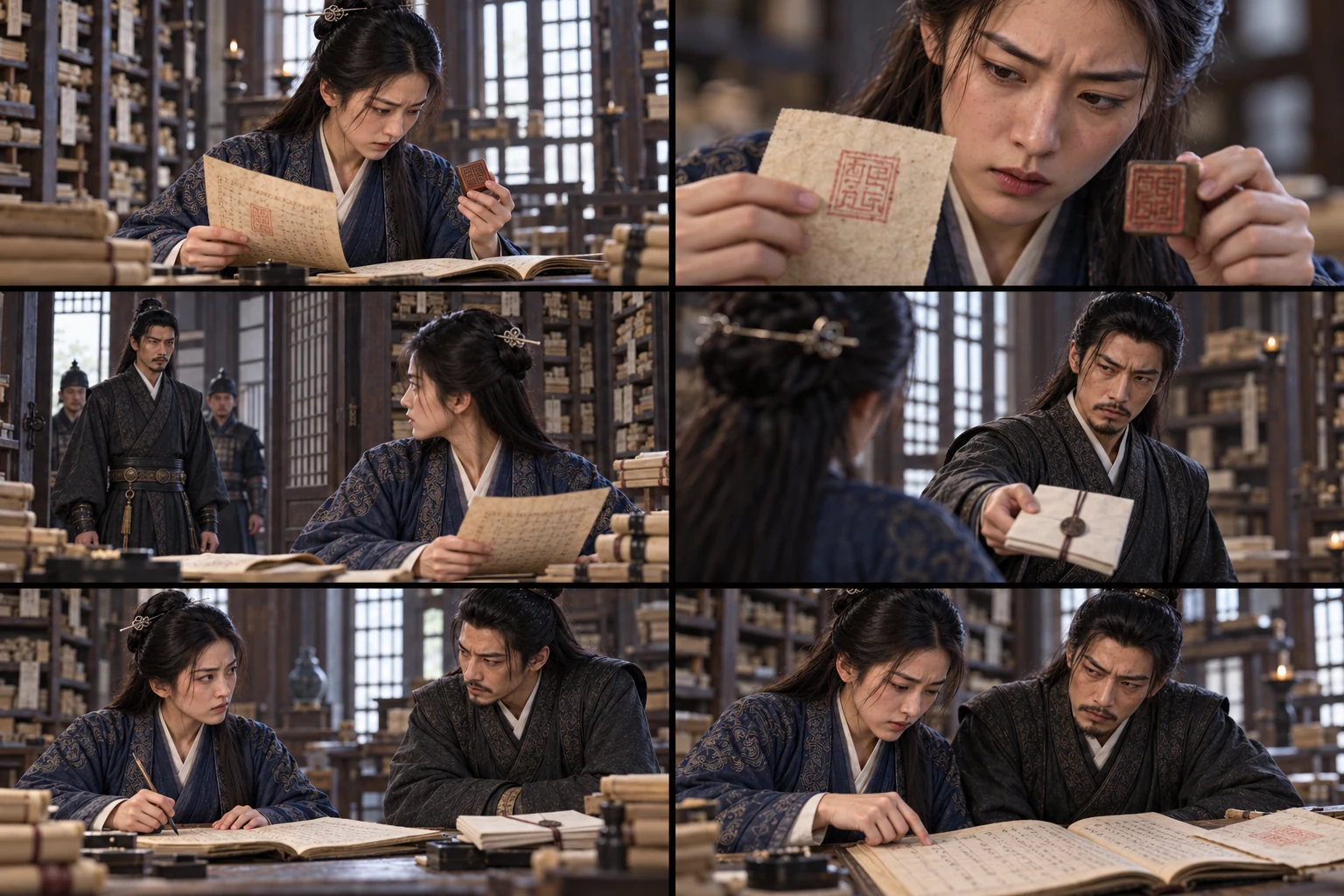
Begin with an image that carries evidence. Yue compares two seal impressions; the later one is too clean. Let the audience see the mismatch before explaining the archive’s entire history.
- Evidence: Yue places the decree beside the archived impression and aligns the seal marks.
- Interruption: Lu Wen arrives with an order to retrieve the record before morning court.
- Choice: Yue asks him to sign the custody record; Wen pauses because the order has no witness.
- Reversal: a second ledger entry shows Wen’s office received an earlier copy.
The reversal creates a precise new question without proving Wen’s guilt. Storyboard the paper position, seal insert, hand movement, each gaze and the shift in distance between the leads. Keep the key text legible on a phone and return to the characters after the insert. For a contrasting scene built on physical action rather than evidence, see the Last Ferry fight sequence.
Use framing, costume and light to clarify power
Choose a visual rule for each space. Cool daylight can define the archive; warmer light can sit near the court threshold. Keep skin tone and exposure stable across coverage. Establish who controls access in the wide shot: Yue inside the archive boundary, Wen at the door. After the evidence changes the relationship, frame them on the same side of the table. These are deliberate cinematic choices, not claims about historical lighting.
For every shot, specify lens distance, camera height, direction, gesture, gaze target and the held document. “Yue notices the seal, stops turning the page, then looks at Wen” gives a performer and storyboard artist an observable action; “make it mysterious” does not. Review the adjacent shots for costume, face, paper, hand position and light. See how visual contrast can carry an emotional turn.
The decree changes hands; the facts do not
A visible chain of custody turns a prop into dramatic evidence.
Discover
Shen Yue sees the altered mark
Decree remains flat on her desk.
Conceal
Lu Wen arrives before she can report it
Seal orientation and folded edge stay fixed.
Challenge
He asks for the original
She reveals the evidence without surrendering custody.
Decide
They must choose who witnesses the handover
End on a consequential choice, not a random close-up.
Fictional scene plan. A transfer must be visible or clearly motivated in the edit.
Assign factual and creative review separately
For any real historical reference, keep a source note beside the scene and mark details that remain uncertain. Ask a knowledgeable reviewer to check the details visible in the final sequence before they are described as factual. For fully invented settings, state that they are fictional and avoid attaching the story to real people or institutions.
Agree approvals in order: world rules, character and costume bible, episode outline, script, storyboard, sample scene and final cut. The person approving historical detail may differ from the creative decision-maker. Bring the intended historical reference, key costume or prop evidence, and the person who can check it. Our AI microdrama production in Singapore service shows how those choices are scoped.
Common questions
Is The Jade Ledger based on a real Chinese dynasty?
No. It is a fictional palace mystery. Any real period detail used in a production should be researched and reviewed separately.
How do you maintain period costume and prop continuity?
Record each character’s visual anchors and track costume wear, document state, prop position, hand occupancy and character knowledge by scene.
What should a period-drama storyboard show?
Show access to the space, the evidence, hand actions, eyelines, costume state and the visual change that makes the next decision clear.
Bring us the story you want to tell.
Tell us your audience, target markets, languages and the kind of series or microfilm you have in mind. We’ll discuss the creative direction, pilot and production scope with you.