In this guide
- Make the fight expose the couriers’ competing goals and later choice.
- Map the dock and screen direction before designing choreographed beats.
- Use a qualified choreographer and review full performance, prop continuity and performer comfort.
Make the fight change the rivalry
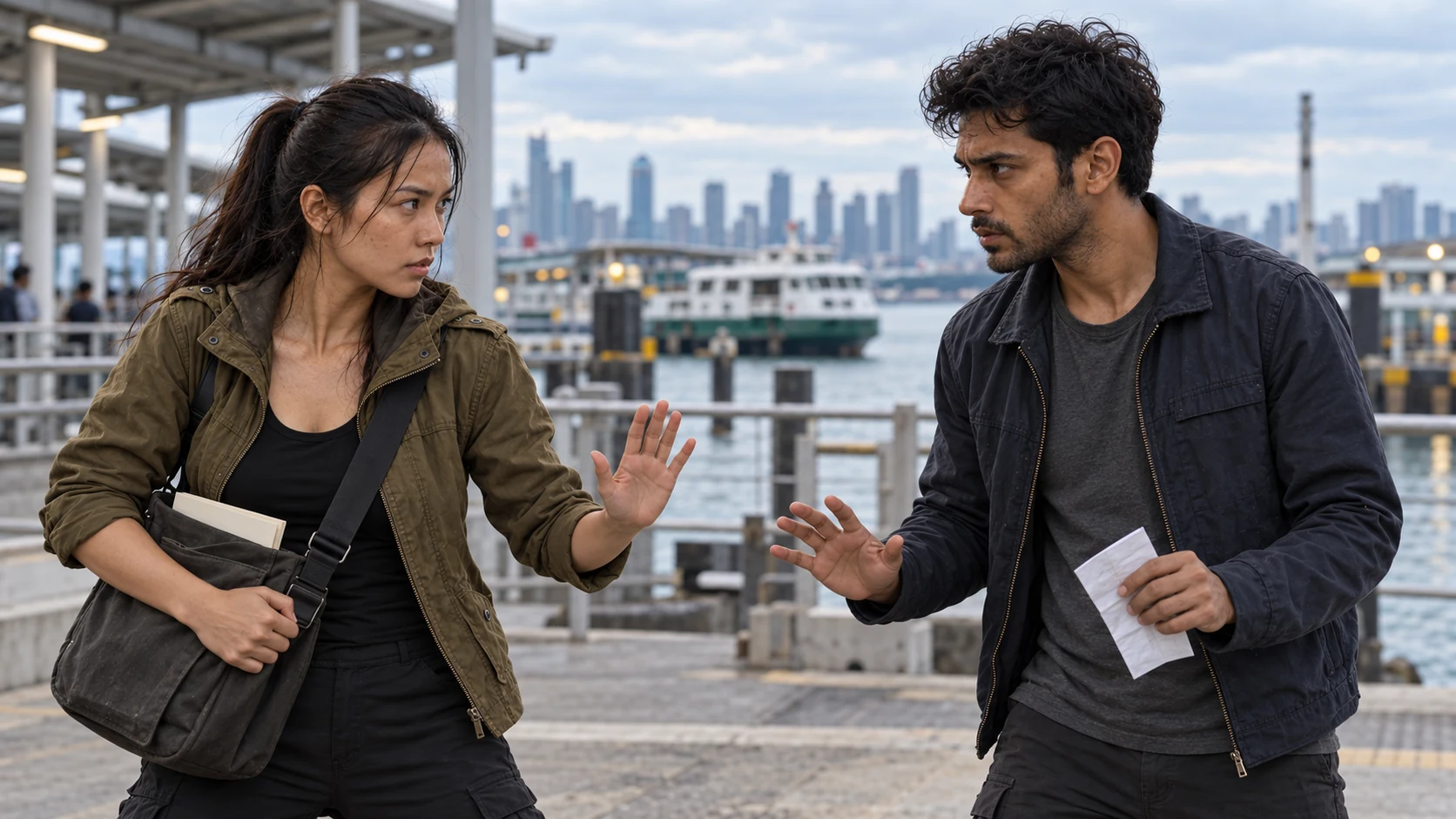
Fight drama works when movement carries a disagreement. Decide what Maya and Arjun each believe, what each wants to protect, and what makes conversation fail before the ferry leaves. The choreography should make those intentions visible: Arjun tries to claim the dispatch; Maya protects the envelope; both discover that their competition risks missing the recipient.
They are not a hero and villain. Maya, a courier, trusts the assignment she received. Arjun, her rival, believes the route record names him. Their rival claims create the scene; the fight exposes how they respond under pressure. Keep that emotional cause clear before adding cuts, impacts or music.
For the story architecture behind a different kind of episode turn, read how a microdrama moves from pressure to a changed choice.
Give each courier a readable intention and arc
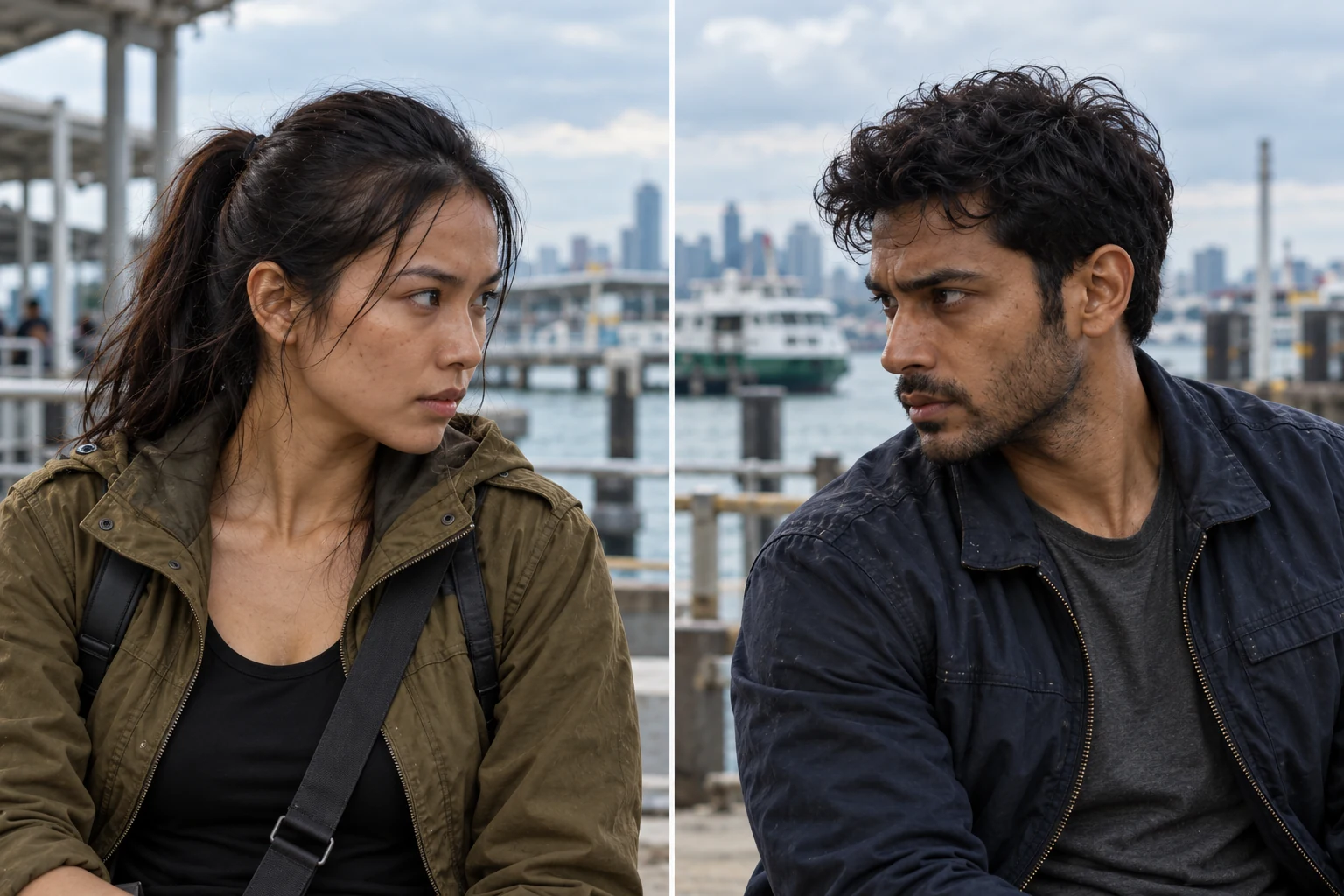
Maya carries the sealed envelope in a cross-body bag and checks dispatch details before she speaks. She moves from protecting her claim alone to agreeing to verify the delivery with Arjun.
Arjun carries a dispatch pouch and a folded route slip that he treats as proof of his claim. He is proud of his record and reluctant to trust a competitor. His change is visible when he stops advancing, looks past Maya to the waiting recipient and chooses cooperation. Keep both characters’ costume, bag, envelope and eyelines consistent so a viewer can follow the conflict without explanatory dialogue.
The visual reference sheet should show face, jacket, bag and neutral stance. The scene board then records their positions and props; the reference does not replace reviewing the moving performance.
Establish screen geography before choreography
Map the dock, ferry gate, marked waiting area, barrier and open space selected for the scene. Mark Maya and Arjun’s initial positions, camera side, route to the recipient and where the envelope can safely land. Start with a wide shot that lets the audience orient. Maintain screen direction through the exchange; use a deliberate reset shot if the axis must change.
For each setup, note who advances, who yields, where the envelope sits, which path remains clear and what the camera can see. The audience needs to know who controls space at each point, even when editing tightens the rhythm. A still can show initial blocking, but adjacent shots and the full cut must confirm that performers and objects move continuously.
For complex character or prop continuity in a different genre, see the Jade Ledger scene-state record.
For 9:16 dock framing and a separate landscape view, see the vertical production guide.
Keep the audience oriented
Last Ferry · illustrative blocking, not a stunt or safety instruction
- Maya · screen left
Satchel against her right hip
Cream envelope stays secured with her.
- Arjun · screen right
Route slip in his left hand
He can show evidence without taking the envelope.
- Boarding gates · right
One shared destination
Both eyelines turn toward the same call.
- Camera side
Stay on the established side for the exchange
Use a neutral reset if a later shot changes orientation.
Qualified choreography and performer safety are separately required for physical action.
Storyboard four fight beats
Build the exchange around the envelope and a clear shift in purpose. Storyboard the opening distance, each reaction and the point where the couriers notice the waiting recipient.
- Challenge: Arjun claims the dispatch and stands across Maya’s route.
- Exchange: brief advances, defensive reactions and resets change the balance between them.
- Reversal: Maya sees the recipient beyond the gate; Arjun follows her gaze.
- Choice: the boarding signal makes completing the delivery more urgent than winning the argument.
Keep the envelope secured with Maya and the route slip with Arjun throughout this version. Return to an establishing angle before a major position change so the viewer can connect the reaction to its cause.
What breaks in AI-generated action, and how we review it
Assess generated action as a continuous performance. These are production checks to apply to the actual output, not a claim that every tool fails in the same way.
Movement loses weight or direction
Compare the approach, contact cue and recovery at normal speed, then inspect the transition. Simplify the beat or rebuild the shot if the body changes direction without a readable cause.
Hands, clothing or faces change
Compare the shot with the locked cast references and adjacent coverage. Reject identity drift, intersecting limbs or changing costume details before editing around them.
The prop jumps or changes owner
Track the envelope and route slip through every cut. Restore the agreed prop state instead of using an insert to conceal an unexplained handoff.
The cut reverses the space
Check eyelines, screen direction and the ferry-gate position against the scene map. Re-establish the route or replace the angle when the audience would lose orientation.
Watch the rebuilt sequence again as a whole: a corrected frame is not enough if the transition into the next shot still breaks the action.
Review the actual performance and every cut
Keep a shot log for starting position, camera side, hand occupancy, costume state and prop owner. Compare each cut with the next planned state; in this version, the envelope remains with Maya throughout the confrontation.
For filmed or hybrid scenes, use an appropriately qualified choreographer, agree movement boundaries and a stop signal, and rehearse in a controlled space. Do not add improvised contact during a take. The responsible team must assess the actual performance and simplify or restage anything unsafe or unclear.
The regional version log records timing or caption changes. For visual identity, use the adjacent-shot character check.
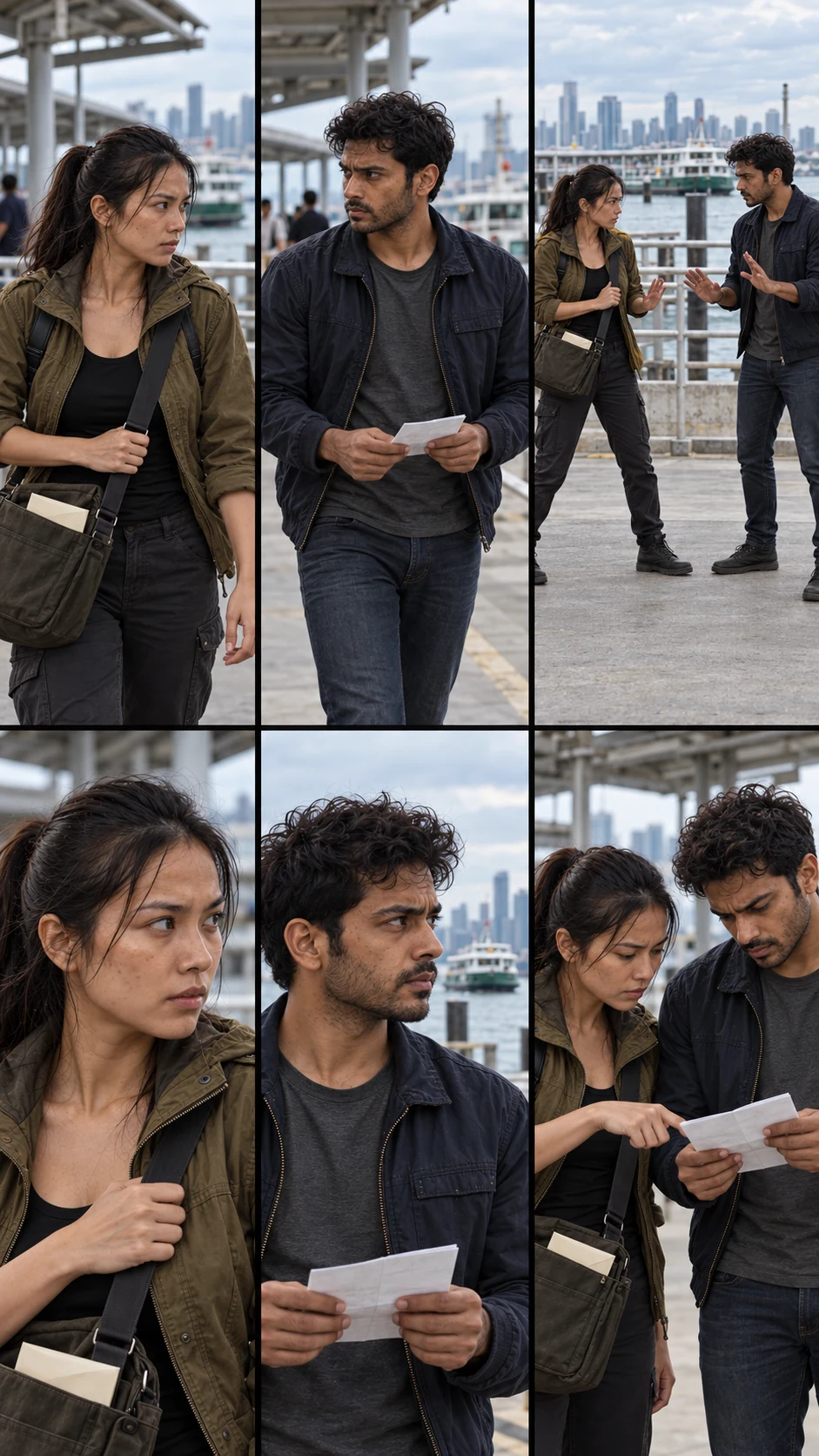
Three beats, three visible changes
A readable action moment is built from intention, reaction and evidence.
Beat 1 · Protect
Maya shields the satchel
The audience sees who has the envelope.
Beat 2 · Interrupt
Arjun presents the route slip
The physical challenge becomes a question.
Beat 3 · Verify
They compare the dispatch information
Keep both props and the decision legible before cutting.
The conflict must change what the characters do. Random impacts do not advance this story.
Brief the Singapore action pilot around review decisions
Bring three action-specific inputs: the dispute that triggers the confrontation, a simple location map, and the props whose ownership must remain clear. Indicate whether the scene is generated, filmed or hybrid so its performance checks can be planned.
Our AI microdrama production in Singapore service sets the concept, storyboard and sample-scene gates. In the sample, check whether the audience can follow the couriers’ route, see who holds the envelope and understand their final choice.
Common questions
How do you make a short fight scene readable?
Establish the space and screen direction, show each character’s intention and reaction, and make the final beat change the relationship or goal.
What review does a filmed fight scene need?
For filmed or hybrid scenes, a qualified choreographer should plan the movement with the responsible production team, set boundaries and a stop signal, and assess rehearsal and the actual take.
Can an AI-generated fight scene skip human review?
No. Even a non-graphic generated fight needs human checks for movement, identity, prop ownership, screen direction and the reason each character changes course.
Bring us the story you want to tell.
Tell us your audience, target markets, languages and the kind of series or microfilm you have in mind. We’ll discuss the creative direction, pilot and production scope with you.