Quick answer: AI web development in Singapore means building a site with AI-assisted tooling for code, copy and imagery, under senior human engineering review. It shortens first drafts and content production, not the whole project: a premium SME site still takes roughly 4 to 8 weeks and sits in the same market price tiers. It does not, by itself, make a site visible in ChatGPT or Google AI Overviews.
On this page
What is AI web development?
AI web development is the design, build and maintenance of a website where AI-assisted tooling produces the first drafts of code, copy and imagery, and senior human engineers and creative directors review, correct and ship the result. AI is the production foundation of the build rather than a bolt-on tool, and search engineering for Google, AI answer engines and generative engines is planned from the first wireframe.
It is not "we used ChatGPT to write the about page" or "we generated one hero image". Those are tactics on top of a traditional build. An AI-native build changes the whole production stack:
- Content production — photography, video and copy are drafted through AI pipelines in the brand's voice and visual language, then reviewed by humans before anything ships.
- Search engineering — schema, answer-first content blocks and entity signals are built into every template by default rather than retrofitted.
- Iteration speed — design and content variants can be produced in days, so more rounds of real feedback fit inside the same timeline.
- Localisation — one production pipeline can serve Singapore, the wider region and other English-speaking markets without a separate shoot or copy team per market.
- Quality control — a creative director and a senior engineer sign off every output; the model behind a draft matters less than the review wrapped around it.
In practice a Singapore build runs through brand-book ingestion (fonts, colour, voice and entity definitions as guardrails), sitemap and AEO targets set before design, AI-drafted imagery and copy under review, schema engineering, Core Web Vitals tuning, and launch with sitemap and search-engine submission. The rest of this guide covers what that changes in speed, cost and visibility — and what it does not.
What AI-assisted web development actually changes
Three things change in an AI-assisted build: first-draft speed, how content is produced, and where the review time goes — not whether the build still needs a senior engineer. That distinction matters more than most pitches make it sound.
- Speed. AI-assisted tooling compresses scaffolding and first-draft code meaningfully, which shows up as faster working prototypes and shorter gaps between review cycles.
- Content, not just code. The more practical shift for most Singapore briefs is content production: pages can launch with brand-accurate, AI-generated copy and imagery from day one instead of Lorem Ipsum placeholder text and stock photography waiting to be replaced later — which is usually where "almost finished" websites stall for months.
- Iteration. Faster first drafts mean more rounds of real feedback within the same timeline, rather than one slow build-and-reveal.
What does not change: AI-assisted code can look entirely plausible and still be subtly wrong, insecure, or a poor fit for the existing system. There is no version of this where human engineering review becomes optional. AI Studio's build process runs on frontier coding models, a proprietary production workflow, and senior human engineering direction on every build — the model behind the first draft matters far less than the review process wrapped around it.
AI-assisted vs traditional build: when each wins
Neither approach wins universally. The honest comparison depends on what the site actually needs to do.
| Approach | Where it wins | Trade-off |
|---|---|---|
| AI-assisted build | Standard-to-moderate complexity sites, content-heavy builds, brand-accurate content from day one, faster first draft and more review rounds | Still needs senior engineering review; not a shortcut for deeply custom systems |
| Traditional hand-coded build | Highly bespoke systems, deep legacy integration, novel architecture with no established pattern to draw on | Slower first draft, higher cost per iteration |
| Low-code / template platforms | Fastest launch, lowest cost, minimal customisation needs | Limited differentiation; harder to customise design and AEO structure later |
What it costs in Singapore
AI-assisted delivery does not collapse Singapore web development pricing into one number, because the cost driver was never mainly "typing the code" — it is design decisions, content production, integration complexity and revision rounds. Published Singapore market ranges already span roughly S$5,000 for a brochure site to S$200,000+ for a custom platform, depending on scope; see the full tier breakdown on our website development company page.
What actually shifts with AI-assisted delivery is where the advantage shows up: content production (no placeholder text or stock imagery to swap out later) and first-draft speed, which can compress an SME build toward the faster end of its timeline band without moving it into a different price tier. It is a timeline and quality lever, not a discount mechanism.
How AI-built sites get found in AI search
Being built efficiently with AI and being visible in AI search are two separate problems — this is the single most common misconception in this space. A site being "AI-built" says nothing about whether ChatGPT, Perplexity or Google AI Overviews will ever cite it. Getting found in AI search runs through three distinct disciplines, and it matters that they stay distinct rather than getting blurred into one buzzword:
- SEO (Search Engine Optimization) — the foundation: semantic HTML, fast load times, clean technical structure, ranking in Google's organic results.
- AEO (Answer Engine Optimization) — structuring content and schema so AI answer engines cite the site as the direct answer to a question.
- GEO (Generative Engine Optimization) — getting the brand recommended by name inside generative AI responses, not just linked as a source.
A technically clean AI-assisted build gives you the foundation SEO needs. It does not, by itself, give you AEO or GEO — those require deliberate entity signals, structured data and citation-worthy content engineered on top of that foundation. We tracked this directly on our own site: publishing eight AEO-structured pages moved daily AI citations 61-fold within 24 hours, while the underlying technical build stayed unchanged. The data behind that is in What 38,000 AI Citations Taught Us.
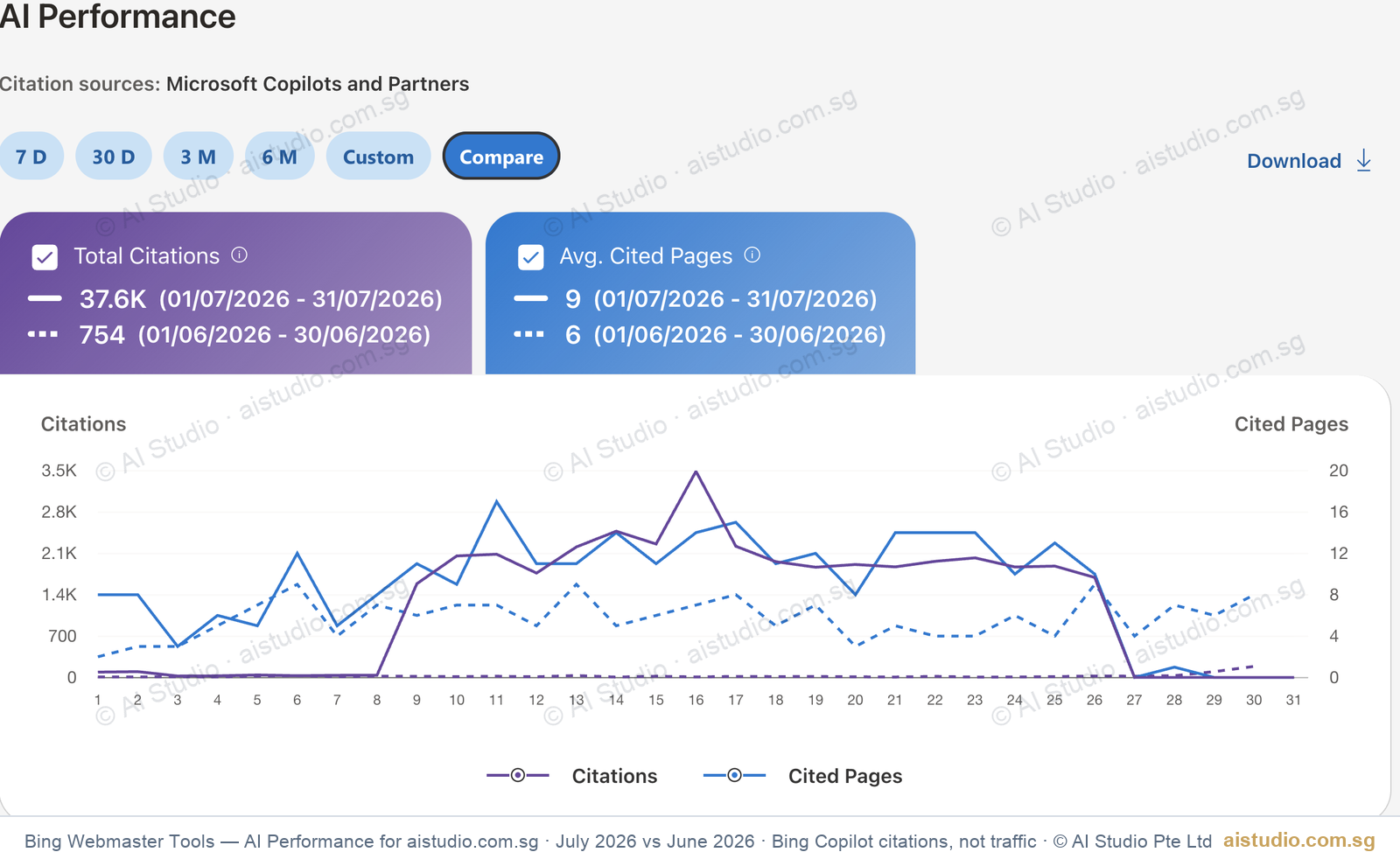
If AI search visibility is the actual goal, the build and the AEO/GEO strategy need to be planned together rather than treated as a follow-on task. See how that works on our AEO Singapore service page.
Security, PDPA and maintainability basics
Security. AI-assisted code gets the same code review, testing and staging discipline as any other code — if anything, more scrutiny, because plausible-looking output is exactly where review attention lapses. "The AI wrote it" is never a reason to skip a security pass on authentication, data handling or third-party integrations.
PDPA. If the site collects personal data through forms, accounts or cookies, the usual PDPA obligations apply regardless of how it was built. It gets more specific the moment the live site itself uses AI features that touch customer data — a chatbot or AI-assisted tool calling a model API. Singapore's PDPC published finalised advisory guidelines on generative AI and personal data in July 2026, and they separate the obligations of model providers, system providers and system deployers. A Singapore business running an AI feature that calls ChatGPT, Claude or Gemini through an API is a deployer, with its own accountability for the personal data it sends.
Maintainability. A fast first build creates technical debt fast if it isn't paired with clean architecture and documentation — speed and maintainability are a discipline decision, not an automatic outcome of the tooling. The same applies to AI-search visibility: without quarterly AEO/GEO review, launch-day rankings decay within a couple of quarters, the same as any site.
How to brief a build
An AI-assisted build moves faster when the brief arrives complete. Before the first conversation, prepare:
- Brand assets — logo, colours, existing photography or a willingness to use AI-generated brand-accurate imagery
- A content inventory, or a clear steer if content should be AI-drafted from your brand voice
- Must-have integrations — payments, CRM, booking, inventory, existing marketing tools
- Two or three reference sites you like, and what specifically you like about them
- A realistic timeline and budget band, not just a launch date
- One accountable decision-maker for sign-off, to avoid design-by-committee delays
Related builds: Web Development Singapore, Web Design Singapore, E-commerce Website Singapore, and for bespoke systems beyond a marketing site, Custom Software Development Singapore. If what you actually need is an AI-powered application rather than a marketing site — a chatbot, a knowledge assistant, an automation dashboard — that is a different build; see AI Web Application Development in Singapore. Need a mobile app rather than a website? Start with native vs cross-platform app development, and before you hire for a bespoke system run through the questions to ask a custom software developer.
Planning a build and want it found in AI search too?
Tell us the brief and the goal. We'll scope the build and the AEO/GEO foundation together, not as an afterthought.
Frequently Asked Questions
Is AI-assisted code production-safe?
Only with the same engineering discipline any code needs: review, testing and a human who understands the system it sits in. AI-assisted code can look plausible and still contain subtle logic errors, security gaps or a mismatch with the existing codebase, so it goes through the same senior review, testing and staging process as hand-written code before it reaches production — never a straight copy-paste to live.
Who owns the code AI helps write?
The client, under the same terms as any custom development engagement. AI-assisted tooling changes how the code gets written, not who owns the resulting work product — that is settled in the development agreement the same way it would be for a fully hand-coded build.
How long does an AI-assisted web build take in Singapore?
Timelines still track scope rather than collapsing to one number: a premium SME site typically runs 4 to 8 weeks, multi-market e-commerce 8 to 16 weeks, and custom platforms 12 to 32 weeks, per published Singapore market ranges. AI-assisted delivery compresses the first-draft and content-production steps most, which shows up as fewer review cycles rather than a fundamentally shorter project.
Does AI-assisted development change our PDPA obligations?
No. If the site collects personal data through forms, accounts or cookies, the usual PDPA obligations apply regardless of how the site was built. Where it gets more specific is if the live site itself uses AI tools that touch customer data — a chatbot or AI-assisted feature calling a model API — because Singapore's PDPC guidance on generative AI treats the business running that feature as a deployer with its own accountability for the personal data it sends.
Does an AI-assisted site still need ongoing maintenance?
Yes, and arguably more predictably than a hand-coded site if the initial build was rushed without documentation. Security patches, content updates, performance monitoring and periodic AEO/GEO review still apply — AI search criteria shift often enough that a site without ongoing review can lose visibility within a couple of quarters, the same as any other site.
Will an AI-built site rank in AI search automatically?
No, and this is the most common misconception. Being built efficiently with AI-assisted tooling and being visible in ChatGPT, Perplexity or Google AI Overviews are separate problems. A technically clean build is a necessary foundation — semantic HTML, schema, fast load times — but AEO and GEO visibility require deliberate entity signals, structured data and citation-worthy content on top of that foundation, not a byproduct of how the code was written.
Is AI web development the same as building a site with ChatGPT, v0 or a website builder?
No. Generating code or copy snippets with a consumer tool is a tactic inside a traditional build, and a template website builder is a different product again. AI web development in the sense used here changes the whole production stack — content, imagery, schema and AEO/GEO engineering drafted through AI pipelines — with senior engineers and creative directors reviewing every output before it ships.
Related reading
- AI Web Application Development in Singapore
- What 38,000 AI Citations Taught Us
- AEO Agency Singapore
- Web Development Singapore
- Website Development Company Singapore
- The complete guide to web development in Singapore
- Native vs cross-platform app development
- Questions to ask a custom software developer
- what AI website development actually means