What is AI search, in one line?
Quick answer: AI search uses platforms such as ChatGPT, Gemini, Perplexity, Claude and Google AI Overviews to assemble answers, sometimes with supporting sources. AI Studio coordinates SEO, AEO and GEO work around useful pages, accurate company facts and evidence. Search rankings, linked citations and recommendations remain separate outcomes.
Why has search moved into AI engines?
Buyers can use AI answers to explore a category, compare options or ask follow-up questions. Traditional search remains part of that journey. The useful question is where your own customers research and what evidence they find about your brand.
Sources: Google reported that AI Overviews passed 2 billion monthly users in its Q2 2025 earnings call; OpenAI reported 800 million weekly ChatGPT users at its October 2025 developer event. The engines that matter for buyers in Singapore: ChatGPT, Claude, Perplexity, Gemini and Google AI Overviews. Read why Singapore brands should invest in AI search now for the full business case.
One brand, three engines
Most agencies still sell "SEO" and stop. But a buyer's journey now runs across three different machines — and each is won differently. We work all three as one system: the Triple-Engine Framework™.
Search Engines
The classic blue links and the index everything else is built on. Clean technical foundations, the right pages for the right intent, no self-inflicted ranking damage.
Answer Engines
The single boxed answer above the results. We structure your content so the engine lifts your wording as the definitive response — and attributes it to you.
Generative Engines
The conversational recommendation. We improve accurate company information and credible public references so generative platforms have clearer context when buyers ask what to buy or who to hire.
SEO supports discovery. AEO structures useful answers for possible citation. GEO clarifies brand context that may inform recommendations. The workstreams share useful content, crawl access and accurate company information.
| Engine | Where the buyer is | What wins | How we measure it |
|---|---|---|---|
| SEO | Google and Bing results pages | Technical health, intent-matched pages, links | Rankings, impressions, clicks |
| AEO | AI Overviews, featured answers, Copilot | Answer-first copy, FAQ and Article schema | Citations and quoted snippets |
| GEO | ChatGPT, Claude, Perplexity, Gemini chats | Entity clarity, third-party mentions, llms.txt | Brand named in recommendations |
Takeaway: the three engines share one foundation but reward different signals, which is why we run them as one programme rather than three vendors. The complete guide to AI search optimization walks through each layer in detail.
What does AI search optimisation actually involve?
AI search isn't a content trick — it's an engineering job on the layer machines read. Our process is deliberately two-pass: fix what's broken, then build the identity that makes engines trust you.

Two-pass AI-search audit
A technical hygiene review followed by a closer look at useful content, business facts and supporting evidence. The audit documents what was checked and which changes belong in the next release.

Company facts and public references
Accurate first-party company information, relevant Organization markup and genuine public profiles. These help describe the business consistently without inventing credentials or third-party authority.
Structured data & schema
Relevant structured data that describes actual visible content and supported business facts. We avoid unsupported review markup and do not treat schema as a promise of an AI citation or Google feature.

llms.txt & AI access
Review crawl access for the relevant search bots and distinguish it from training permissions. An optional llms.txt can summarise public pages, but it is not a documented requirement or guaranteed source for ChatGPT, Claude or Perplexity.

Answer-first content craft
Clear answers, useful comparisons and supporting detail, revised against the page's existing purpose and target keywords. Changes are reviewed in the browser and measured after publication.

Submit, track & monitor
Submit sitemap updates to Google and Bing, then track an agreed set of buyer questions across selected AI platforms. Record the platform, prompt, date and answer; report added research separately so comparisons remain consistent.
We optimized ourselves first
Our own website is reviewed using the same disciplines: crawl and indexing checks, useful pages, accurate company facts and separately reported search observations. Technical checks establish what was implemented; they do not prove a traffic or citation uplift.
Technical foundations
Check public page responses, canonical URLs, crawl policies, internal links and markup that matches visible content.
Useful buyer answers
Review service information, question coverage, evidence and the route from a useful answer to a relevant enquiry.
Accurate company context
Keep first-party business facts consistent and distinguish founder experience, company history and independent coverage.
Separate outcome measures
Report search clicks, linked source citations, brand mentions, recommendations and enquiries with their own scope and dates.
What we can measure on our own site
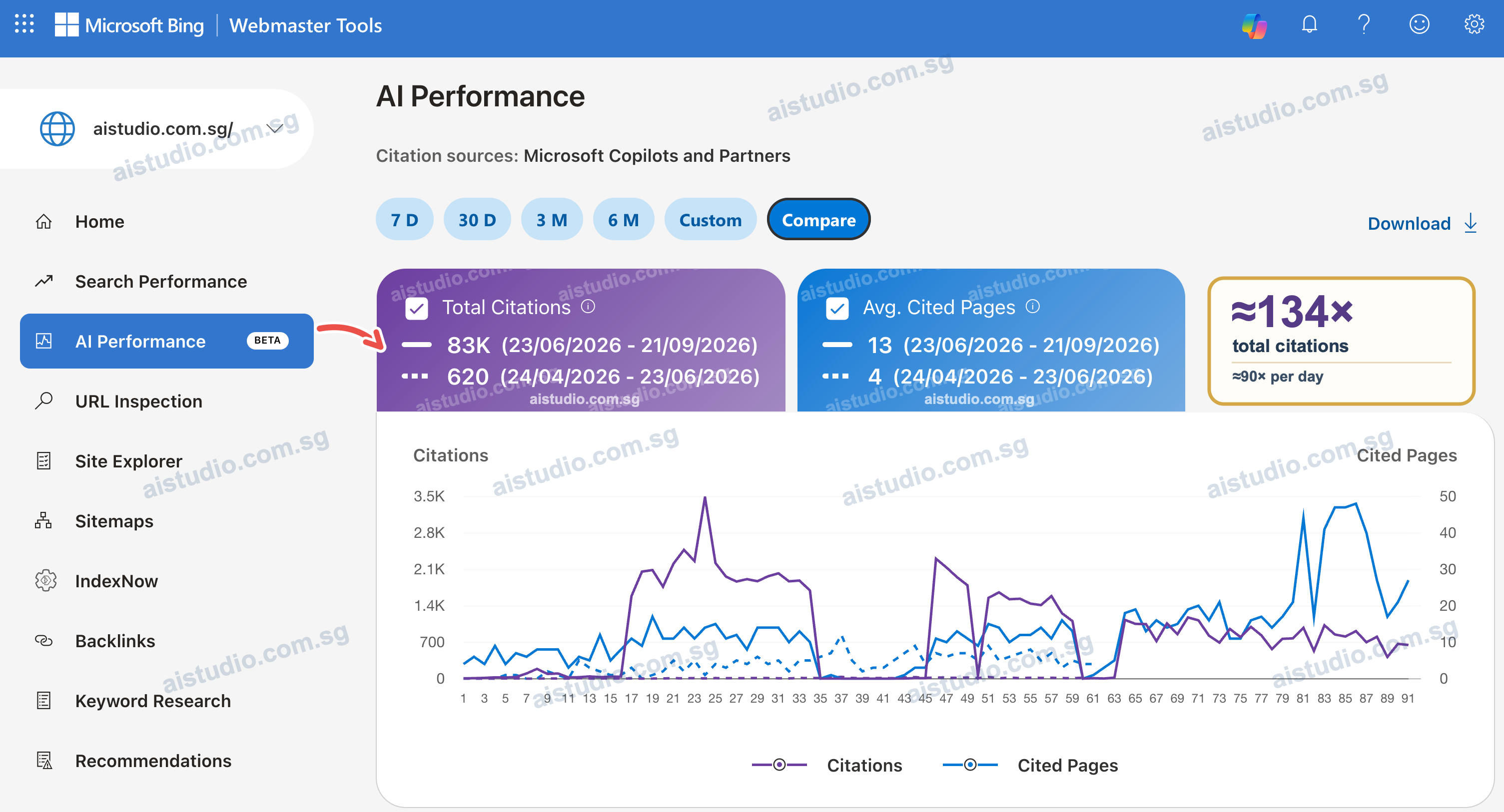
Bing Webmaster Tools records visible source citations across Microsoft Copilot and partner AI experiences. This screenshot is a dated observation of aistudio.com.sg; it does not establish what caused the change or predict a client result.
What changes when your brand is the answer?
Here's what changes when a prospect asks an engine about your category — before the work, and after.
- No machine-readable identity for the engine to trust
- Content the engine can't cleanly quote
- Authority signals scattered or missing
- Named by AI engines: rarely, if ever
- A clear
Organizationentity engines trust - Answer-first content built to be quoted
- Authority & trust signals consolidated
- Named by AI engines: the goal of every engagement
Illustrative of the shift we engineer. We target citation and visibility — we don't guarantee a specific ranking, because no honest agency can.
Why does AI search matter now?
AI search rewards the brands that show up early and publish clean signals. The benefits compound.
Get named when it counts
Improve the service information and supporting evidence a buyer can use when comparing providers. Track actual recommendations under an agreed query panel.
Own your entity graph
Keep first-party business information accurate and consistent with genuine profiles and relevant independent coverage.
Accurate structured information
Use supported structured data where relevant and make it match the visible page. Google decides feature eligibility and display; there is no special schema required for AI Overviews or AI Mode.
Understand the competitive context
Assess competitors under the same buyer queries and conditions. Their visibility is evidence for the audit, not a reason to assume an automatic first-mover advantage.
Maintain useful website assets
Build useful website content and maintain accurate information over time. Search and AI-platform visibility can still change, so compare observations against a consistent baseline.
Protect established search intent
Preserve established page addresses and keyword responsibilities, review scoped changes and monitor after release. No website change can guarantee that rankings remain unchanged.
How a 6-month engagement runs
A six-month programme can organise the agreed priorities below. The audit determines the scope, sequence and review cadence. Keep a fixed panel for comparable reporting, and document any additional query research separately.
Audit + entity & authority layer
A technical and content baseline, organisation facts, relevant markup, canonical and crawl checks. Keep search-bot access and training policies distinct; llms.txt is optional.
Surgical schema + answer-first content
Review the first priority pages and relevant structured data. Agree the buyer-query panel, selected platforms and capture conditions before the repeated reporting begins.
Rotate to the next keyword cluster
Review the next agreed group of pages while maintaining the original comparison panel. Record additional query research separately so the reporting denominator stays consistent.
Off-site citation & authority building
Identify relevant public profiles, directories and independent coverage. Outreach, client permissions and third-party editorial decisions are agreed separately; publication is not guaranteed.
Next cluster + refresh earlier ones
Review the next priorities and refresh earlier pages where evidence or buyer needs have changed. Use the agreed review cadence to decide which changes warrant a new release.
Consolidate, report, plan the renewal
Review completed website work and separately observed clicks, citations, mentions, recommendations and enquiries. Use the evidence to agree the next priorities and any continuing scope.
Why AI Studio
✦ All three engines, one team
SEO, AEO and GEO from a single foundation — one AI search agency in Singapore, not three vendors pointing at each other.
✦ We run it on ourselves
We review our own website using the same process. The first-party evidence above records Bing source citations with their dates and limits.
✦ Singapore-first
Calibrated to how buyers search here and what actually has search demand in this market.
✦ Disciplined, not reckless
A locked process built specifically to avoid the self-inflicted ranking damage careless "AI optimization" causes.
Where we work to get you seen:
Explore each engine
✦ AEO in Singapore
Improve the pages that address buyer questions, then track whether answer engines cite them.
✦ GEO in Singapore
Generative Engine Optimization to earn mentions and recommendations inside ChatGPT, Claude and Gemini.
✦ AI search optimization
The full readiness programme that ties SEO, AEO and GEO together into one measurable workflow.
Related reading
- AI search agency Singapore — how a retainer engagement is scoped and run
- Complete guide to AI search optimization — every layer, from schema to llms.txt
- Why invest in AI search now — the business case for Singapore brands
- The future of search and AI engines — where answer engines are heading
- Enterprise AI search visibility guide — for larger, multi-market organisations
- AI SEO agency Singapore — the Google and Bing side of the same foundation
- SEO Singapore complete guide
- SEO trends Singapore 2026
AI search questions buyers ask us
Is AI search optimisation different from the SEO we already pay for?
SEO supports discovery in Google and Bing. AEO and GEO add buyer-question and brand-context work for AI answers. They share useful content, crawl access and accurate information. Google says no special schema or AI text file is required for its AI search features; other platforms choose their own sources.
How long before our brand is named in AI answers?
There is no dependable timeline for an engine to cite or recommend a brand. Our dated Bing screenshot records 83K source citations from 23 June to 21 September 2026 versus 620 in the shorter 24 April to 23 June window. These are observations, not traffic, leads or a prediction for another business.
Will this damage the Google rankings we already have?
No agency can guarantee that rankings will remain unchanged. We preserve established URLs and page responsibilities, avoid creating competing destinations, review scoped copy and markup changes, and compare post-release search data against a consistent baseline.
Does AI search matter for a regulated or B2B business?
Yes, and often more than for consumer brands. In finance, healthcare, professional services and B2B, buyers research quietly by asking ChatGPT, Gemini or Perplexity before they shortlist anyone, and the engines lean heavily on clear entity signals and verifiable third-party mentions. Regulated categories need careful wording, so we work within your compliance constraints and avoid any claim an engine could misquote.
Can AI search visibility actually be measured?
Yes. Use a fixed set of buyer questions and record the platform, prompt, market, collection date and full answer. Report named mentions, recommendations and linked source citations separately, with valid-answer counts and missing results visible. Where available, first-party Bing AI Performance data adds a separate site-level citation measure. Repeat the same cohort and compare complete periods; a changing answer position is not a guaranteed rank.
Explore the AI search programme
Review how AI Studio scopes SEO, AEO and GEO work around your website, buyer questions and available evidence.
See the integrated SEO, AEO and GEO programme Revisit the Triple-Engine